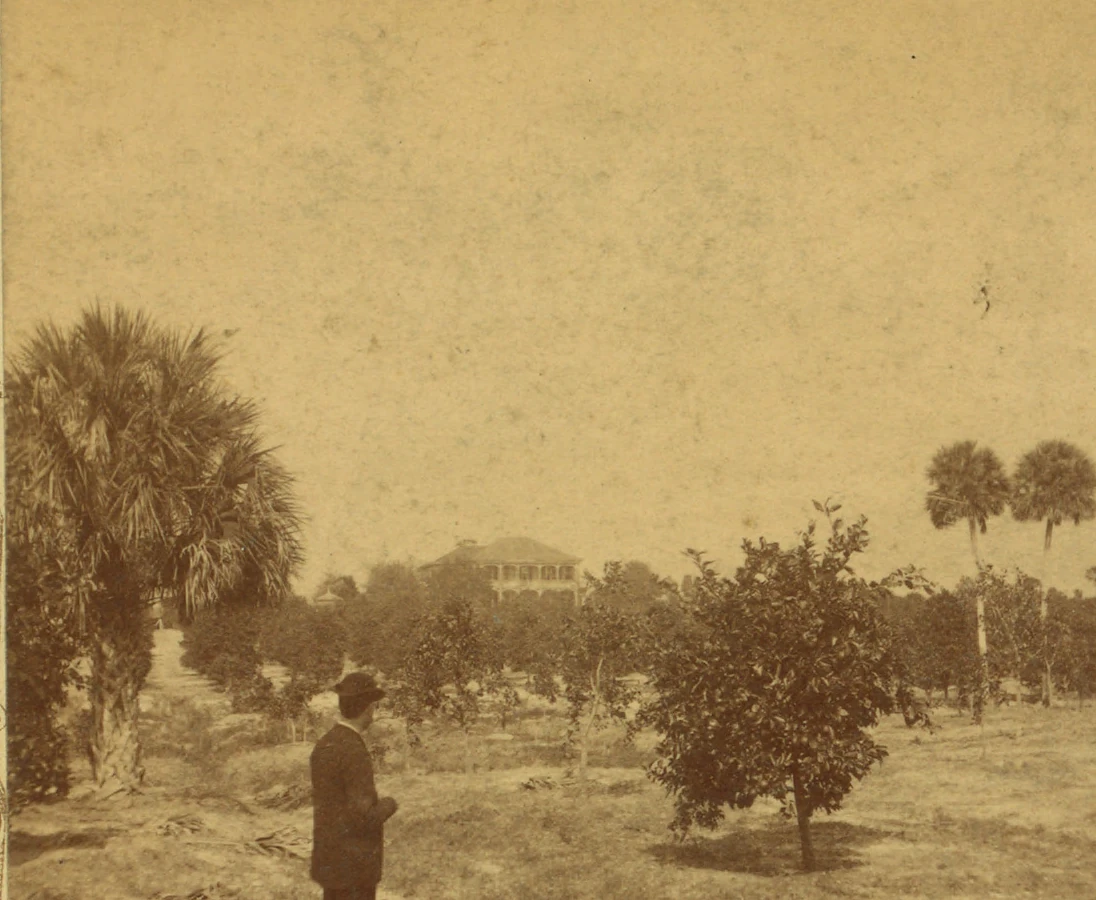
Say the name out loud — Yalaha — and you’ve already said the thing the town was built on. The settlers on this stretch of Lake Harris took it for a Native word meaning the orange, and when the place finally needed a name, that’s the one they chose. Not a founder. Not a saint. A fruit.
Which is a strange thing to name a town after, once you sit with it — stranger still because the orange isn’t from here either. It came over on ships, generations back, and had to be carried inland tree by tree. So how does an empty shelf of pine and lake water end up named for a fruit nobody here grew up with? The short answer is that a few men bet everything they had that it would pay, and the name is the receipt.
The emptiest shore in the lake country
Start with how alone the first of them was. Ebenezer Jackson Harris came down to the south side of this lake around 1845 with a young wife and a small boy. By the account read at his funeral, “his nearest neighbor lived on one side of the lake fifteen miles and on the other side forty miles distant.” Forty miles to the next family. That’s the kind of room we’re talking about.

He could have had almost any patch of it. What he wanted was this one, on the water, and he wanted it badly enough to — the funeral account again — “undergo a great many deprivations rather than give up a locality so attractive.” Then he did something that tells you exactly how he saw the place.
The government surveyors had come through and marked his lake as Lake Eustis, after an Army colonel. Harris didn’t care for that. He argued, and kept arguing, until the name was changed to Lake Harris — his own. A man forty miles from his nearest neighbor, out in country barely on the map, and the first thing he nails down is that the lake will carry his name.

Why oranges, of all things
Harris wasn’t out here for the view, or not only. He had a theory, and it was a big one. “His attention was thus early turned to the culture of the orange,” the account says, “and he believed that the profits attending the same would lead to the speedy settlement and development of the country.”
Read that twice. He thought the orange would build the towns. Not the other way around. Plant enough groves and the people would come to work them, and the stores and the churches and the roads would follow the fruit inland. The empty forty miles weren’t a problem — they were the opportunity. All that room was waiting to be filled, and the orange was going to be what filled it.

It very nearly didn’t work — for him. Harris’s own grove got into the scale insect, a pest that was chewing through Florida groves at the time, and that, plus the plain fact that his children had no school within reach, finally wore him down. He sold the place on the lake, moved up to Ocala, and became a hotel keeper. The man who got the lake named after himself gave up on the orange before it ever paid him.
The grove that took
But he wasn’t the only one who’d done the math. Around the same stretch of Lake Harris, in the same decade, a North Carolinian named Melton Haynes was making the identical bet — and sticking with it. Haynes brought sweet-orange seed to the lake and put in a grove that ran to a hundred and sixty acres. A hundred and sixty acres of one fruit, in country that fifteen years earlier had almost nobody in it.

Haynes is the one history gives the credit to: the first sweet oranges in central Florida, the start of what became the whole industry. He built a home up the lake he called Woodlea, on “the lake of the dancing sunbeams,” and worked his grove until he died. His place was on the north side, nearer what grew into Tavares — but when he was buried, it was in Yalaha ground, a few miles down the same shore from where Harris had started. Two men, one lake, one fruit. One of them quit and got a lake. The other stayed and got an industry.
So they named the town after it
By the time there were enough families scattered around the south shore to need a post office — that was 1874 — the orange had done exactly what Harris said it would. People had come for the groves. And when those people had to put a name on the little settlement, they didn’t reach for a founder or a hometown back east. They reached for the fruit itself.
Yalaha. A word they understood to mean the orange, or the yellow-orange — the standard reference on Florida place names records it the same way. The whole town, named after the crop it was planted to grow. It’s about the plainest piece of branding a place ever did: here is what we are, and here is what we’re selling, said in one word on the post office door.
Most towns are named for a person who got there first. Yalaha was named for the reason anybody came at all.
You can’t grow a grove on a town lot
None of it works without room, and that’s the part that outlasted the oranges. A hundred and sixty acres doesn’t fit on a neat village square. The whole model — Harris’s theory, Haynes’s grove, every family who came after — needed land, and lots of it, spread out along the water. You cleared what you could, planted the trees, and built onto the place a little at a time: a house, then a packing shed, then a dock, then another grove when you’d saved for it.
And getting the fruit back out was its own problem, because there were no roads worth the name. The lake was the road. Steamboats worked up the Ocklawaha and across the chain of lakes, and Yalaha became a landing — a shipping point where crates of fruit went down to the water and out toward the markets up north.

When the railroad finally reached down into the lakes in 1880, it didn’t replace the water so much as meet it: the train ran from Astor down through Umatilla to Fort Mason, and from there lake steamers carried passengers and freight on to Leesburg, Tavares, and Yalaha. You can watch the whole country fill in on the maps of the decade — the lakes, the little rail lines threading between them, the groves spreading along every shore.

The winter that called the bet
Then came the test, the one every orange town in Florida remembers. In the winter of 1894 and 1895, two freezes hit about six weeks apart, the second one worse because a warm spell in between had coaxed the trees into budding. Groves that had taken twenty years to grow were killed in a night, up and down the state, the lake country as hard as anywhere.

Harris had already learned the hard lesson decades early, with his scale insects: a town that is only one fruit is a town that can be wiped out in one bad season. But Yalaha didn’t vanish the way some one-crop places did. The groves that could be replanted came back, slowly, and citrus stayed part of the living — now packed and loaded and shipped as a real business, once the rails were close enough to take the crates.

What the room became
Yalaha never grew into a city. It never even incorporated. It’s still an unincorporated stretch of Lake County on the south shore of the lake, between Leesburg and Tavares, still quiet, still spread out along the water. The thing that most people drive out there for now isn’t a grove at all — it’s a German bakery that opened in 1995 and sits on twenty-five rural acres, pulling tour buses and motorcycle clubs down the same county roads the steamers once fed.
Which is its own kind of proof. A bakery needs twenty-five acres for the same reason a grove needed a hundred and sixty: out here, the room is the whole point. The oranges mostly moved south generations ago, chased by freezes and by the cost of the land. But the room they needed never went anywhere. It’s still the first thing you notice when you turn off the highway — the yards that run back forever, the groves gone to pasture, the houses with space on every side.
Harris was right in the end, just slower than he hoped and in a way he couldn’t have pictured. The orange did fill this country with people. And the name he never chose — the name of the fruit — is still the one on the sign, over ground that still has room to spare.


