Tildenville, Florida  ·  A Local History

The Town That Grew Out of
One Man’s Orange Grove


Between Winter Garden and Oakland there’s a stretch of old grove country named for one man — who came to Florida sick, bought a few hundred acres of sand on the south shore of Lake Apopka, and ended up growing a whole town on it. The strange part is what’s still standing, now that the oranges are gone.

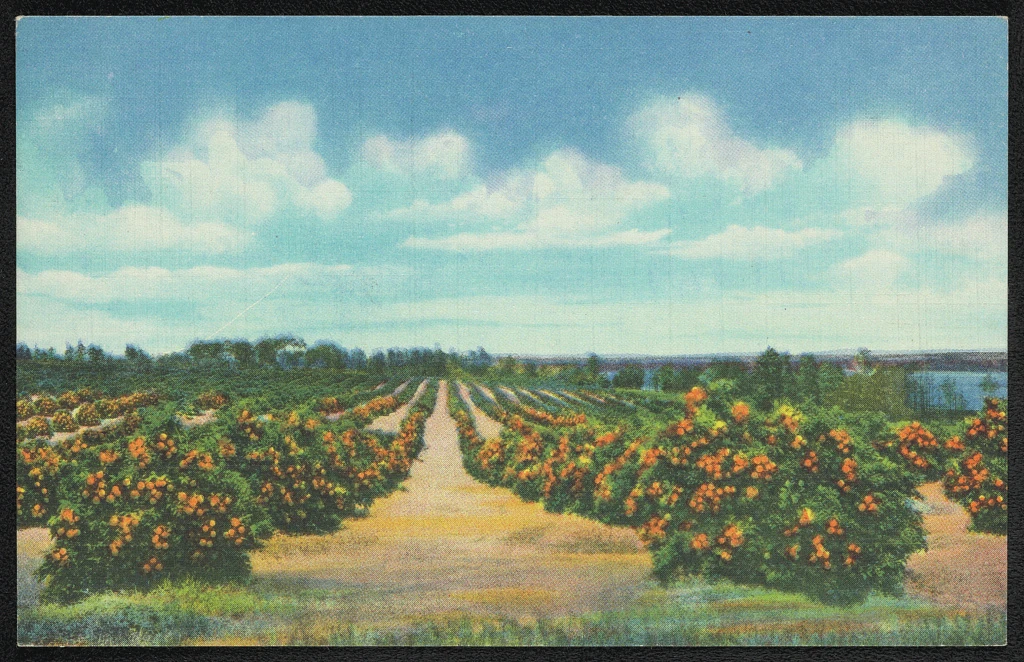
Rows of orange trees heavy with ripe fruit running back toward a lake under a bright sky, in tinted color.
What the whole place was built on
Citrus, as far as the money went. A Central-Florida grove heavy with fruit, “Lake Region, Florida,” Detroit Publishing Co., 1908; Library of Congress. A representative grove of the era, not Tildenville itself.

There’s a dead man’s name all over this stretch of road between Winter Garden and Oakland. It’s on the elementary school. It’s on Tildenville School Road. And for about sixty years it rode out of here stamped on the side of every wooden crate of oranges that left the place — three letters, L.F.T. The man was Luther Fuller Tilden, and he came down to Florida in the 1870s because a doctor up north had listened to his chest, heard bronchitis, and more or less told him to go somewhere warm while he still could.

He did not go quietly. He bought five hundred and sixty-one acres of high, sandy ground on the south shore of Lake Apopka — nine dollars an acre — and planted a town.

That’s the odd thing about Tildenville. It isn’t named for a battle or a railroad or a saint. It’s named for the farmer who owned it, because the whole place grew outward from his groves the way a tree grows out from its trunk. And the reason it could is the plainest thing in the world. Out here, there was room.

What one man does with that much room

The first thing he did was figure out the fruit. Back then an orange got to market however it survived the trip — packed badly, or not packed at all, and bruised to mush by the time it reached a cold city up north. Tilden packed his right, and he put his initials on the crate so a merchant in Baltimore or New York knew what he was getting before he even pried the lid. L.F.T. meant Luther had packed it; C.H.T. meant his son Charles had. Same promise either way.

Inside a citrus packing plant: workers in shirtsleeves standing at long roller belts grading oranges, with wooden field bins and crates of fruit on the floor.
Grading the fruit by hand
Pack it right, stamp your name on it. Workers grading and packing citrus inside a Florida packing plant — the kind of operation Tilden was among the first out here to build. Arthur Rothstein for the Farm Security Administration, 1937; Library of Congress. A representative Florida packinghouse, not Tildenville’s own.

Before the railroad reached this corner, getting the crop out was its own feat — hauled by ox and mule team up to Sanford, then floated down the St. Johns River to Jacksonville and the ships. The Tildens kept buying ground and planting it, and within a generation they were one of the biggest landowning citrus families in this part of the state.

And an operation that size isn’t just trees. It’s a whole machine, and Tilden built every part of it out on his land because he had the land to build it on. A growers’ association went up over in Oakland, with a packinghouse on Tildenville School Road and its own brands on the crate — South Lake, Good Will. That same packinghouse ran a power plant, and starting around 1910 it sent electricity into the houses of Tildenville and Oakland, with one catch a modern person can barely picture: every night at eleven o’clock they shut the whole thing off, and the town went dark till morning.

A 1917 Sanborn fire-insurance map sheet of Winter Garden, Florida, showing the Plant Street business blocks in color-coded building footprints, two railroad lines, a bank, a hotel, churches, an ice and light plant, and a small inset map of Florida.
Winter Garden — 1917
By now there was a town to map. The 1917 insurance map of neighboring Winter Garden — population 1,500, with its own Light & Water Co., two railroads, and a block of brick storefronts. Sanborn Map Company, May 1917; Library of Congress, Geography & Map Division.

By 1919 the family and their partners had spun up the Tildenville Power Company, and the next spring it was lighting Winter Garden too. A schoolhouse had already gone up back in 1905, on land a neighbor family gave. A town made out of fruit still needs the things a town needs, and one by one, on that room, they got built.

Who actually picked it

A grove, though, is only worth what somebody’s willing to climb a ladder in the heat to pick. The oranges didn’t gather themselves, and the people who gathered them are half the reason there’s still a Tildenville at all.

A citrus worker in a cap and overalls reaching into a fruit-laden tree to pick oranges, a picking bag slung across his body.
The work the whole thing ran on
Somebody picked every one. A Central-Florida citrus picker at work in a grove. Marion Post Wolcott for the Farm Security Administration, 1939; Library of Congress. A representative grove worker of the era, not Tildenville itself.

A county history tells it plainly: the first residents were mostly people who came up from Alabama and Georgia to work the groves, and stayed. Many were Black families, and the work — picking, hauling, packing, grove after grove — ran on them. They lived where the work was, in modest wooden houses built right out among the trees on the grove land. A settlement grew up here through the 1930s and ’40s. Nearly twenty of those little labor houses are still standing. A church went up in 1939, and for decades its lights were the only streetlights the neighborhood had.

The Tildens grew vegetables too — they were among the first in the state to ship them — so between the groves there were fields: beans, cabbage, the muck crops that liked the low wet ground down near the lake. Picking season, packing season, planting season. For a long time there was always work, and the work was always right here.

A crew of farm workers bent over harvesting a muck vegetable field, crates stacked at the edge and a packing shed behind them.
Between the groves
Vegetables on the low, wet ground. A crew harvesting a Central-Florida muck field — the kind of vegetable work that ran between the citrus seasons. Arthur Rothstein for the Farm Security Administration, Sanford, 1937; Library of Congress. A representative muck-belt field, not Tildenville itself.

The two freezes

Florida citrus has one mortal enemy, and it isn’t bugs. It’s a cold night.

A sepia photograph of a bare, leaf-stripped orange grove behind a wooden fence, the ground littered with fallen fruit after a hard freeze.
The winter of ’95
A cold night does what nothing else can. A Florida orange grove stripped by the Great Freeze. “Frozen grove,” 1895; UCF / Orange County Regional History Center. A representative freeze-killed grove of that winter.

The first time it nearly ended everything was the winter of 1894 and ’95 — the Great Freeze, the one old Florida families still measure time by. It killed the trees across the middle of the state and sent ruined settlers packing. Tilden, who by then had money, lent out his animals and his equipment and carried neighbors who’d lost everything, and slowly the groves came back.

The second time, they didn’t. The hard freezes of the 1980s came through and finished the citrus in this part of Orange County for good — the growers who rebuilt did it a hundred miles south, and up here the groves just stopped. The picking work that had pulled families from Alabama and Georgia dried up with them.

A man kneeling at a campfire on a wooded lakeshore, a boat pulled up at the water's edge behind him and a string of large bass hung on the pine tree beside him.
When the lake still fished
The other thing the lake was good for. A camp on a Florida lake with a stringer of bass — the sort of scene that ringed Lake Apopka when it was one of the best bass lakes in the country. Library of Congress, circa 1925. A representative Florida fish camp of the era.

And the lake itself, the one Tilden had settled beside, was in its own slow trouble. Decades of farm runoff off the far shore had turned one of the finest bass lakes in the country into one of the most polluted lakes in the state; the fish camps that once ringed it closed one after another. The oranges left. The fish left. The thing the whole town had been built on was, almost all at once, gone.

What a town’s made of, after

So go looking for the groves today and you mostly won’t find them. Subdivisions, the Turnpike, a shopping center carrying the Tilden name. The south end of the old community got sliced clean off into a little pocket called Possum Hollow when the Turnpike went through.

Out here the land was never the scenery. It was the asset — the thing a whole life got built on top of.

But the room is still legible, if you know how to read it. The big packinghouse buildings still stand on Tildenville School Road, rented out now to small businesses. Two of the houses Tilden built are still there. His son’s place — a wide-porched Classical Revival house called Meadow Marsh, out on its acreage — is somebody’s home again after years as an inn. Nearly twenty of the grove-workers’ houses are still lived in. The church still gathers. The families who came to pick and stayed seventy years are still here.

A large two-story white Classical Revival house with a deep wraparound porch, dormer windows and a hipped roof, set back on a green lawn under mature trees.
Still standing — Meadow Marsh
The house the groves paid for. Meadow Marsh, the Luther F. Tilden House on Tildenville School Road, built for Tilden’s son and now on the National Register of Historic Places. Present-day photograph; Ebyabe, via Wikimedia Commons. The genuine house, in Tildenville.

The old rail line that carried the fruit out is a paved trail now, and it runs straight through the middle of Tildenville, past the grove ground, under the live oaks. People walk it in the evening along the same route the oranges once took out of town.

A paved recreational trail curving through green Florida countryside past a small trailhead with signage and a red post, trees on both sides under a blue sky.
The old fruit line, today
Where the oranges used to roll. The West Orange Trail where it runs through Tildenville, on the bed of the old railroad that once shipped the citrus out. Present-day photograph, 2005; via Wikimedia Commons. The genuine trail, in Tildenville.

The oranges are gone. The man who stamped his initials on them has been gone since 1929. The lake nearly died. But the road still carries his name, and the houses — the grand ones he built and the plain ones his workers built — are still standing on the same wide ground that made all of it possible in the first place. A town that started as one man’s orange grove turned out to be built by everyone who came to pick it. And the thing it was really made of, the thing that outlasted the fruit and the freezes and the lake, was never the citrus. It was the room, and what people kept deciding to put on it.

A present-day note · Orange Tiny Homes

The room out back is still where the useful thing goes.

Tildenville got built on one plain rural-Florida habit: when you’ve got ground, you put something useful on it. A grove. A packinghouse. A schoolhouse. A second little house out among the trees for the family that worked the place. The room out back was never decoration — it was where the next needed thing went.

That instinct still pays, and these days the thing people build out back has a name — an ADU, an accessory dwelling unit — and it’s what we build. A granny flat so a parent can live close with their own front door. A guest house. A rental out back that helps carry the mortgage. A tiny home on the far corner of the lot. Same idea those old Tildenville lots were settled on, just with a kitchen, a bathroom, and a permit.

And you don’t need grove acreage to do it. All over greater Orlando — the roomy west-county lots around Winter Garden and Oakland, sure, but also ordinary yards in Conway, Pine Hills, Azalea Park and Meadow Woods — plenty of homes already have the space. What actually decides it comes down to your own address:

The real answer to “is there room out back for this?” isn’t a guess — it’s a handful of facts about your lot. That part we can check for you.

Put in your address and we’ll pull what your parcel allows and tell you whether a granny flat, guest house, rental, or tiny home actually fits — before you spend a dollar on drawings.

Start the ADU Fit Check→
Sources & Photo Credits

On the history

What is documented and what is inferred: Tildenville survives in county records, the Winter Garden Heritage Foundation’s files, two Orange Observer histories, a 2021 Orange County article, and the census — not in a deep photographic archive of the groves themselves. Of the images below, only the present-day Tilden House (Meadow Marsh) and the West Orange Trail photographs are of Tildenville specifically, and the 1917 Sanborn map is of neighboring Winter Garden. The grove, the packing plant, the orange picker, the muck field, the frozen grove, and the fish camp are each identified in their captions as representative period Central-Florida scenes standing in for the citrus, packing, grove-labor, vegetable, freeze, and lake history described here. Sources differ slightly on Tilden’s arrival year (1875 vs. 1876); that is noted rather than resolved. Full notes are in source-record.md beside this page.

Photographs & maps

  1. Orange grove, “Lake Region, Florida” (hero) — a Central-Florida grove heavy with fruit; Detroit Publishing Co., 1908; Library of Congress. Representative, not Tildenville. File: florida-orange-grove-1908. loc.gov
  2. Citrus packing plant interior — workers grading and packing citrus; Arthur Rothstein, Farm Security Administration, 1937; Library of Congress. Representative Florida packinghouse (the negative code strip is cropped out). File: citrus-packing-plant-1937. loc.gov
  3. Winter Garden, 1917 (Sanborn map, sheet 1) — the Plant Street business district, two railroads, the Light & Water Co., population 1,500; Sanborn Map Company, May 1917; Library of Congress, Geography & Map Division. File: winter-garden-sanborn-1917. loc.gov
  4. Citrus picker — a Central-Florida grove worker picking fruit; Marion Post Wolcott, Farm Security Administration, 1939; Library of Congress. Representative, not Tildenville (the 35mm sprocket edges are cropped out). File: orange-pickers-1939. loc.gov
  5. Harvesting a muck vegetable field — a Central-Florida muck-belt crew; Arthur Rothstein, Farm Security Administration, Sanford, 1937; Library of Congress. Representative of the vegetable work between citrus seasons. File: muck-vegetable-field-1937. loc.gov
  6. Frozen grove, 1895 — an orange grove stripped by the Great Freeze; UCF / Orange County Regional History Center. Representative of the 1894–95 freeze. File: frozen-grove-1895. stars.library.ucf.edu
  7. Camping on a Florida lake — a lakeside camp with a boat and a stringer of bass; Library of Congress, circa 1925. Representative of the fish-camp era on lakes like Apopka. File: lake-fish-camp-1925. loc.gov
  8. Meadow Marsh (Luther F. Tilden House) — the Classical Revival house on Tildenville School Road, NRHP-listed; present-day photograph; Ebyabe, via Wikimedia Commons. The genuine house, in Tildenville. File: tilden-house-today. source
  9. West Orange Trail at Tildenville — the rail-trail where it runs through the community; present-day photograph, 2005; via Wikimedia Commons. The genuine trail, in Tildenville. File: west-orange-trail-tildenville. source

Original downloads and a full research record are kept alongside this page in assets/images/originals/ and source-record.md. No historical image was altered in any way that changes its content; cropping was limited to negative borders, a film code strip, and sprocket edges. The Polaroid frames and handwritten notes are CSS added around the images, never onto them.