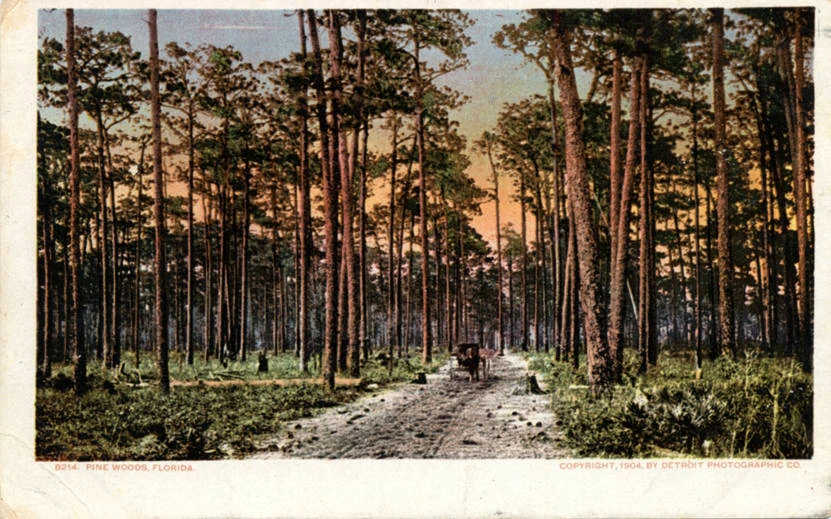
Drive south out of Orlando, past the airport, and you’ll go right through a place called Pine Castle. Nice name. Sounds like a subdivision — the kind of name somebody picks because it’s pleasant and means nothing. Except this one means something. There really was a castle out here. A man built it, out of pine trees, on the edge of a lake, and the town is still named after a house that’s been gone for well over a century.
So who builds a castle in the flat pine woods south of Orlando? And why would a place hang onto the name of a building almost nobody alive ever saw?
A castle, out of pine
The man was Will Wallace Harney, and he did not come here to build a castle. He came here heartbroken. Harney was a newspaper man up in Louisville — an editor, a poet people actually read — and in 1869 he packed up and made the thousand-mile trip down to Central Florida, mostly hoping the warm weather would help his wife, Mary. She died within days of getting here. He was left with an infant son and a piece of raw land on the west shore of Lake Conway.

What he did have was room. A homestead on the frontier meant acres of pine and palmetto and sand — far more than one grieving man and a baby could ever use. And out of that empty ground, Harney built something strange. Not a cabin. A house made from the pine growing right there on his land, with two turrets by the front door, walls of boards stood up vertical instead of laid flat so the whole thing looked taller than it was, and a two-story octagon room in the middle, twenty-four feet across, capped with castle peaks and a steep gothic roof you could pick out from any direction. He called it his Pine Castle.
“The house stands on the edge of a slope, a double-winged structure around a central octagon of two stories twenty-four feet in diameter, surmounted by castellated peaks and gothic pointed roof visible at every angle.” Will Wallace Harney, describing his own house
The one-man chamber of commerce
Harney never really made his living off that land. He made it with a pen. He kept writing — long dispatches back to big Northern papers like the Cincinnati Commercial, describing Florida to people who’d never laid eyes on it: the orange groves, the pine forests, the alligators, the whole warm strange wilderness of it. This was back when almost nobody up north had any picture of Florida at all, and Harney handed them one. People have called him a one-man chamber of commerce, which is about right.
And the house kept turning up in the writing. The Pine Castle. It became the most striking landmark between Orlando and Kissimmee — the thing you told a traveler to watch for. The name stuck, and then it spread. By 1879 the post office out there had taken it: Pine Castle. A few years later, so had the town. A whole community, named after one man’s odd pine house on a lake.

Everybody out here built the same way
Here’s the part that outlasted the castle. The way Harney did it — get a piece of ground with room on it, then build the thing you actually want out of what’s standing there — that wasn’t just him. That was how the whole place got made.

Families came down, claimed their acres, and cleared a little at a time. Orange trees went in first — the grove was the payday, a crop you could ship north in the dead of winter when the rest of the country was buried in snow. Then a house. Then a barn, a packing shed, a pen for a few head of cattle, a second little place out back when more family turned up. Nobody built it all at once. You built what you needed, when you needed it, because the room was there to keep adding on.

Citrus was the point of nearly all of it. Set out the trees, wait a few years for them to bear, and a grove paid you back every winter like clockwork. The last thing the growers needed was a way to get the fruit out, and in the early 1880s they got it: the South Florida Railroad pushed a line down through the pine, and suddenly the oranges could reach a market and the town had a reason to grow.

Orlando itself was barely more than a frontier town at this point — look at a bird’s-eye drawing of the city from 1884, the same stretch of years Pine Castle was taking shape a few miles south, and you’re looking at a place still mostly surrounded by woods and water.


The castle goes, the name stays
The castle itself didn’t last. By the time it burned, in 1894, Harney had long since drifted off — the grand house had stood empty and falling apart, and then one night it was gone. He moved up to Jacksonville to live with his grown son, and died there years later. The most striking landmark between Orlando and Kissimmee left behind almost nothing you could photograph.
Which is the strange thing about Pine Castle. The castle is the one part that didn’t make it. What survived was everything around it — the groves, the lanes, the family names on the street signs, and the name itself, fixed to a whole community that mostly never once laid eyes on the house it’s named for.
What’s still out there
A few of the old homes made it. Over on Randolph Avenue a frame house from 1885 is still standing, still lived in — white picket fence, wraparound porch, the kind of place raised back when the rule was plain: get your ground, build what you need, leave room to add on later.

Pine Castle isn’t the frontier anymore. Orlando grew down and wrapped all the way around it; the airport hums away just east; the groves are mostly subdivisions now. But drive the older streets along the Conway lakes and you can still feel it — the deeper lots, the places with a little ground left behind the house. The castle’s gone. The room it sat on never went anywhere.
Will Wallace Harney showed up here with nothing but grief and a piece of pine woods, and built the exact thing he wanted out of it. The town’s been doing some version of that ever since.


