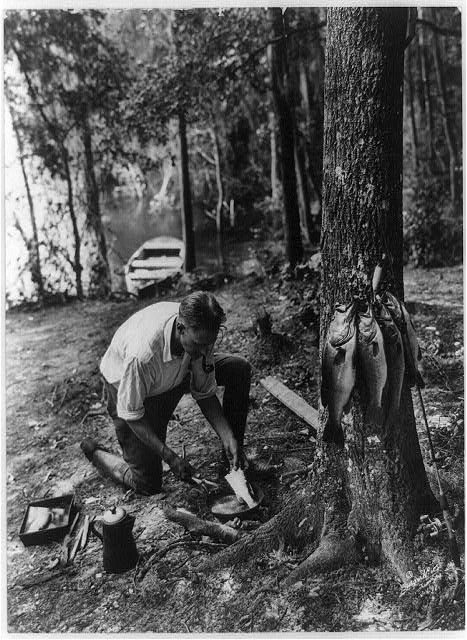
Drive through Paradise Heights today and it’s easy to miss. Big lots. A horse or two. Orange trees gone half-wild along a fence line. A bass boat on a trailer in somebody’s side yard. That boat is the whole story, and you’d never guess it.
Because the lake just down the hill — Lake Apopka — was once one of the best places in America to catch a largemouth bass. People drove across the country for it. And then, inside about one lifetime, that same lake became the most polluted big lake in the state of Florida.
So the name isn’t a joke somebody played on a subdivision. For a good long while, Paradise was just the truth of the place. The question is what made it a paradise — and what broke it.
The lake everybody was chasing
Before the theme parks, before the toll roads, the thing that first put this part of Florida on the map was water. Mapmakers called it the “Lake Region” — a scatter of big shallow lakes strung through Orange, Lake and Sumter counties, with railroads racing each other to connect them. You can see it on an 1885 map: lines converging on little lakeside stops like Apopka and Zellwood.

Lake Apopka was the giant of them — one of the biggest lakes in Florida, and shallow as a soup bowl. Warm, weedy, sunlit all the way to the bottom. If you wanted to design a factory for growing fat largemouth bass, you’d build Lake Apopka.
And the fishermen found it. By the 1920s and ’30s they were coming from all over the country, and somebody started calling it — out loud, in print — the largemouth-bass capital of the world. More than twenty fish camps grew up around the shoreline to catch the business: docks, bait, a few rental cabins, a man who’d run you out to the good water and back. One whole stretch of shore was called, with no irony at all, Fishermen’s Paradise.
The settlement up on the ridge
Paradise Heights sat on the high ground just above all that — a sandy rise over the lake, which is where the “Heights” part comes from. Three of those fish camps were its own.

The people who settled that rise did what everybody did out here with a piece of ground: they used all of it. Orange groves on the high, well-drained sand. A few head of cattle. A garden big enough to matter.

And because the lots were big and the county was mostly empty, people built whatever the place needed. A packing shed for the fruit. A second little house out back for family, or for a grove hand. A cabin to rent to a winter fisherman who’d come down for the bass. The room out back wasn’t decoration. It was where the next useful thing went.

Years later, Orange County made that habit official. In 1991 it drew a line around Paradise Heights and a handful of places like it and called them Rural Settlements. Out here lots stay big, the county doesn’t run city water and sewer in, and a place that’s technically just an old platted subdivision gets to go on acting like country — even wedged, as Paradise Heights is, right between the growing cities of Apopka and Ocoee.
What broke the paradise
Then the thing that made the lake died, and it’s one of the saddest and most avoidable stories in Florida.
Back in the war years, the government helped throw a levee across the shallow north end of Lake Apopka and drain the marsh behind it to grow vegetables in the black muck left on the bottom. Celery, mostly, and sweet corn. They were good crops, and the soil was some of the richest in the state.

Here was the catch. Every season the farms would flood those fields and then pump the water — loaded with fertilizer — straight back into Lake Apopka. Year after year after year. The lake couldn’t take it.
The clear water went pea-green with algae. The underwater weeds the bass lived and spawned in died off in the gloom. By the mid-1960s there were fish kills you could smell from the road, and the trophy bass gave way to rough fish nobody drives anywhere to catch. The camps started closing. By the mid-’70s you could count what was left on the whole lake on one hand. Paradise Heights’ three were gone, and so were the winter fishermen who’d rented those cabins out back.

A place named Paradise lost the one thing it was named for — and stayed Paradise anyway.
The part still being written
In the 1990s the state did something expensive and genuinely unusual: it bought the farms. Not one or two — the whole north shore, every acre, so no more fertilizer water could go back in.
Then it got stranger. Biologists hauled the rough fish out by the truckload and stocked the lake back up with bass. They started flooding the old vegetable fields back into marsh on purpose, letting the water plants return. And slowly — this is the surprising part — the lake began to come back.

Today there’s a drive that runs for miles out across that restored north shore, and it has turned into one of the best places in Florida to count birds — egrets, ibis, whistling-ducks, and an otter if you’re paying attention.

And the fish are following the birds back. Not all the way back — a lake takes longer to heal than it does to break — but closer every year. The bass boats are showing up on the ramps again.

So the name turns out to be the true part. The lake that made Paradise Heights a paradise broke, the fish camps that were its reason for being closed one by one, and the little settlement up on the ridge is still sitting there anyway — quiet, big-lotted, groves gone shaggy, a bass boat on a trailer in the side yard, waiting on a lake that’s finally turning back into something worth the trip. Whatever else Paradise lost, it never lost the room.


