Lake Pickett, Orlando, Florida  ·  A Local History

Why Orlando Stops at a Blackwater River


Drive far enough east and the subdivisions just end — at a tea-dark little river called the Econ. On the far side: cattle, palmetto, ten acres to a house, and a community that spent a decade making sure it stays that way.

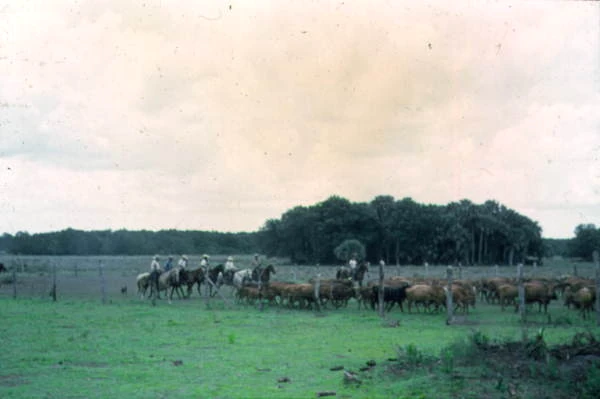
A herd of cattle spread across open Florida range land, a few mounted riders working the edges of it under a wide sky.
What the room out here was for
Cattle, and a lot of room to keep them. Cow hunters moving a herd across the open Florida range — the land use that built east Orange County before anything else did. State Archives of Florida, Florida Memory; a representative Central Florida range scene.

Take any road east out of Orlando and watch what happens to it. The strip malls thin out. The subdivisions get farther apart, then stop. And somewhere out past the last cul-de-sac you cross a small, tea-colored river moving slow through a swamp — the Econlockhatchee, the Econ for short — and on the other side of it the twenty-first century seems to lose interest. Pasture. Palmetto. A horse. A mailbox a quarter mile from the next one.

That’s where Lake Pickett is. And the strange part isn’t that it’s still rural. The strange part is that greater Orlando — a city that paves farmland for a living — drove all the way out here, looked at it, and mostly stopped. Why does the sprawl quit at a creek you could skip a rock across?

The line in the water

Start with the river, because the river is the reason. The Econ is a blackwater stream, stained the color of strong tea by the swamps it drains, and for its first stretch it isn’t really a river at all — it’s the Econlockhatchee Swamp, soft ground that doesn’t want a road or a grove on it. It runs north to the St. Johns, and for most of Orange County’s history it did a simple job: it split the map. West of it, the high dry ground where oranges and towns went. East of it, this.

A narrow dark-water river curving between walls of green trees, a white sandbar and a single canoe pulled up on the near bank.
The Econ — the line itself
The creek the city stops at. The Econlockhatchee River from the Florida Trail bridge, present day — a blackwater stream and one of the larger ones feeding the St. Johns. Photograph by Trougnouf (Benoit Brummer), via Wikimedia Commons, 2013.

The groves that made the rest of the county rich needed well-drained sand and a railroad to ship the fruit. The far side of the Econ had neither, for a long time. So it didn’t fill up with citrus and depots. It filled up with cattle.

A whole county on the hoof

Cattle came to Central Florida before almost anything we’d recognize — before the groves, before the towns, before the name Orlando. The first settlers who pushed down here in the 1840s came driving herds, and the country they turned them loose on was exactly this: flat, open, half-wet pine woods where a cow could wander for miles.

That’s the detail people forget. These weren’t ranches with fences. This was open range. The cattle drifted wherever the grass was, and a couple of times a year the men went out to find them — which is why nobody called them cowboys here. They were cow hunters. They worked the scrub on marsh ponies with long braided whips they could crack like a rifle shot to move a stubborn animal out of the palmetto. That crack is where the word came from. Cracker.

An ink illustration of a lone rider in a wide hat sitting a small horse among tall palmetto fronds, a dog standing in the foreground.
The cow hunter, not the cowboy
“A Cracker Cowboy.” The artist Frederic Remington came through Florida in 1895 for Harper’s and drew the men who worked these woods on horseback. An 1895 illustration, not a photograph. Via Wikimedia Commons.

When the sun went down they weren’t near a house, so they made a cow camp — a palmetto-thatch lean-to, a fire, coffee, and a stretch of ground for the horses. You slept where the herd was. The herd was wherever the room was.

An ink illustration of a thatched open-sided camp shelter in the pines, with men resting under it and one seated by a fire on bare sandy ground.
A cow camp in the pines
Home was wherever the cattle were. A Florida cow camp, drawn by Frederic Remington for his 1895 piece on the state’s cattle hunters. An 1895 illustration. Via Wikimedia Commons.

With no fences, the only way to tell your cow from your neighbor’s was to burn a mark into it. Every cattleman had his own brand, registered at the county seat, and reading them was a daily skill out here — a whole alphabet nobody prints anymore.

A chart of about a dozen old cattle brands drawn in black, geometric shapes and letters, under the hand-lettered heading Old Spanish Brands.
How you told whose cow was whose
The open-range alphabet. A sampler of old Florida cattle brands. On unfenced range, your mark was your fence. State Archives of Florida, Florida Memory.

It was a real industry, not a folk memory. Into the 1900s cattle were still the thing the east county did best, grazing the same flatwoods the cow hunters had worked a lifetime before.

A black-and-white photograph of cattle grazing on open ground among scattered pines, a low fence line running across the background.
Cattle in the flatwoods, 1914
Still the main business. Cattle on the open pine range in Florida, 1914 — the same kind of flat, half-wet country that runs east from the Econ. From a 1914 Florida livestock booklet, via the Internet Archive / Wikimedia Commons.

You built what you needed, and left room

The people who settled this side of the river built the way the land asked them to. You got your acres. You cleared a patch. You put up a house — and then you kept going, adding a barn, a smokehouse, a pen, a second little place out back when more family turned up, because the room was right there to do it with.

A two-story wood-frame farmhouse on cleared ground, a man in a horse-drawn buggy stopped out front and a plowed field behind.
Build the house, then keep adding
Room to grow into. A homestead in Orange County around 1885 — house, buggy, cleared ground, and open space to keep building on. State Archives of Florida, Florida Memory; a representative Orange County homestead of the era.

Look at the county as it stood in 1890 and the whole logic is right there on paper: a tight knot of streets and groves on the west side, and east of them, past the rivers, the open country thins out into ranges and section lines with a settler’s name written here and there across a lot of empty.

An 1890 map of Orange County, Florida, showing a dense cluster of surveyed townships and roads on the west and more open range land laced with rivers and lakes toward the east.
Orange County, 1890 — dense west, open east
The split, drawn out. A map of Orange County, Florida, 1890, marking townships, ranges, and the names of some residents. The settled grove country sits west; the open land runs east toward the St. Johns. E. W. Smith & Co., Philadelphia; Library of Congress, via Wikimedia Commons.

Everywhere else in Orange County, “room” was something you sold off and subdivided. Out past the Econ, room was the whole point — it was what the place was for.

A name the records barely kept

Lake Pickett sits in the middle of all this — a wide, shallow lake on the east side of the river, with the small community that grew up around it taking its name. Who Pickett was, the records are oddly quiet about. No marker, no tidy founder’s story, no castle or courthouse to point to. Just a family name that stuck to a lake and then to the land around it, the way a lot of names out here did — quietly, and without anyone writing down why.

Which fits the place, honestly. This was never country that produced monuments. It produced cattle, and later the ferneries and little farms that like the same damp shade, and people who wanted a piece of ground far enough out that nobody told them what to do with it. The name on the lake outlasted the story behind it. The room outlasted both.

When the city finally came for it

For most of a century the Econ did its job and the far side stayed quiet. Then Orlando ran out of easy land. The city grew east until it was pressing right up against the river, and the open country on the other side — cheap by metro standards, and empty — started to look less like range and more like inventory.

The proposals came one after another. A big new community on the lake. Then another plan for close to two thousand houses on the ranch land north of the water. Each one made the same quiet argument: it’s just open space out there. Why wouldn’t you fill it?

The people who already lived there had an answer. The open space wasn’t empty — it was the reason they were there at all. And instead of selling, they organized, and they kept showing up, year after year, to say so.

They voted to keep the room

It worked, which almost never happens. After more than a decade of residents turning out, the county commission drew the line hard: the land north of Lake Pickett would stay agricultural in Orange County’s long-range plan — zoned, as it had effectively always been, for about one house for every ten acres. Not a house on every tenth of an acre. A house, and then ten acres of room around it. On purpose. In writing.

A lot of the old open country got kept another way, too. Right along the Econ, between the river and Wedgefield, thousands of acres of the same flatwoods and wet prairie the cow hunters rode are now a public preserve — held open for good, cattle trails and all.

And the animal that started the whole thing is still here. Florida Cracker cattle — the lean, horned, swamp-tough breed the Spanish left behind, the one those whips were cracking at — nearly disappeared, then got saved on purpose by people who didn’t want the oldest thing about this country to vanish.

A close-up color photograph of a dark Florida Cracker cow with long curved horns standing in dry open pasture.
The breed that outlasted the range
Still standing in the same grass. A Florida Cracker cow — the small, hardy, long-horned breed worked on the open range for generations, pulled back from near-extinction on purpose. State Archives of Florida, Florida Memory; circa 1980.

So drive east out of Orlando today and the thing that happens at the Econ isn’t an accident of geography anymore. The river stopped the groves on its own, a long time ago. These days it has help — a plan, a preserve, and a lot of people who decided the room was worth keeping.

A present-day color photograph of cattle standing on open pasture near a waterway under a big blue sky with scattered clouds.
Still grazing by the Econ
The same picture, a century on. Cattle on the open ground along the Econlockhatchee, seen from the river, 2015. Photograph by Trougnouf (Benoit Brummer), via Wikimedia Commons.

The cul-de-sacs still stop at the water. The far side is still cattle and palmetto and ten acres to a house. Lake Pickett decided what it was a hundred and fifty years ago — a place with room — and it has been quietly refusing to become anything else ever since.

A present-day note · Orange Tiny Homes

The room out back is still the whole point.

Strip away the cattle and Lake Pickett is a plain Central-Florida idea that never went out of style: get a piece of ground with space on it, build what you actually need, and keep adding as life asks you to. A barn. A pen. A second little place out back when more family turns up. The room was never wasted — it was what let people build the thing they wanted, when they wanted it.

That instinct still pays, and the thing people put out back now has a name — an ADU, an accessory dwelling unit. That’s what we do. A granny flat so a parent can live close with their own front door. A guest house. A rental out back that helps carry the mortgage. A tiny home in the far corner of the lot. The old east-county move, basically — build what you want on the room you’ve got — just with a kitchen, a bathroom, and a permit.

And you don’t need ten acres to do it. Out toward Lake Pickett and the rural east, sure, the room is wide open — but plenty of ordinary Orange County yards closer in have the space too. What actually decides it comes down to your own address:

The real answer to “is there room out back for this?” isn’t a guess — it’s a handful of facts about your lot. That part we can check for you.

Put in your address and we’ll pull what your parcel allows and tell you whether a granny flat, guest house, rental, or tiny home actually fits — before you spend a dollar on drawings.

Start the ADU Fit Check→
Sources & Photo Credits

On the history

A note on evidence: the origin of the name “Lake Pickett” is not documented in the public sources consulted for this page, and is described here honestly as unknown rather than guessed. The cattle-frontier images are genuine records of Florida’s open range — two of them (the cow hunter and the cow camp) are Frederic Remington’s 1895 illustrations, labeled as drawings, not photographs; the cattle, homestead, brands, and 1890 map are period photographs and documents of Central Florida used to show what this country and its work looked like, each labeled above as specific or representative. No image was altered in a way that changes its content. Full notes are in source-record.md beside this page.

Photographs & documents

  1. Cow hunters driving cattle (hero) — a herd and riders on open Florida range. State Archives of Florida, Florida Memory. A representative Central Florida open-range scene. File: florida-cowboys-driving-cattle. floridamemory.com/items/show/1373
  2. Econlockhatchee River from the Florida Trail bridge — present-day color photograph of the blackwater river, 2013. Photograph by Trougnouf (Benoit Brummer), via Wikimedia Commons (CC BY). File: econlockhatchee-river-2013. commons.wikimedia.org
  3. “A Cracker Cowboy” — a mounted Florida cow hunter with a dog among palmetto. Illustration by Frederic Remington, 1895 (“Cracker Cowboys of Florida,” Harper’s). Via Wikimedia Commons. An 1895 illustration, not a photograph. File: remington-cracker-cowboy-1895. commons.wikimedia.org
  4. A Florida cow camp — a palmetto-thatch camp in the pines. Illustration by Frederic Remington, 1895. Via Wikimedia Commons. An 1895 illustration, not a photograph. File: remington-a-bit-of-cow-country-1895. commons.wikimedia.org
  5. Cattle on the open range, 1914 — cattle grazing among pines with a fence line. From a 1914 Florida livestock booklet (“Livestock farming in Florida along the lines of the Florida East Coast Railway”), Internet Archive Book Images, via Wikimedia Commons. A representative Florida range scene. File: florida-cattle-1914. commons.wikimedia.org
  6. Old Florida cattle brands — a chart of early cattle brands (“Old Spanish Brands”). State Archives of Florida, Florida Memory. File: old-florida-cattle-brands. floridamemory.com/items/show/28912
  7. Orange County homestead — the John Anderson homestead, Orange County, Florida, circa 1885; a two-story frame house with a buggy out front. State Archives of Florida, Florida Memory (RC07297). A representative Orange County homestead of the era. File: orange-county-homestead-c1885. floridamemory.com/items/show/30413
  8. Map of Orange County, Florida, 1890 — showing ranges, townships, and the names of some residents; dense settlement west, open land east toward the St. Johns. E. W. Smith & Co. Map Publishers, Philadelphia; Library of Congress (2012592407), via Wikimedia Commons. File: orange-county-map-1890. commons.wikimedia.org
  9. Florida Cracker cow — a close view of the Florida Cracker breed in open pasture, circa 1980. State Archives of Florida, Florida Memory. File: florida-cracker-cattle-c1980. floridamemory.com/items/show/322443
  10. Cattle by the Econlockhatchee — present-day color photograph of cattle on open ground seen from the river, 2015. Photograph by Trougnouf (Benoit Brummer), via Wikimedia Commons (CC BY). File: cows-at-the-econ-2015. commons.wikimedia.org

Original downloads and the full research record are kept alongside this page in assets/images/originals/ and source-record.md. The Polaroid frames and handwritten notes are CSS added around the images, never onto them.