Lake Mary Jane, Florida  ·  A Local History

Before the Medical City,
It Was Cattle Country


Drive a few minutes past Lake Nona’s chrome and glass and the road just quits on you — and there’s a horse in somebody’s yard between two big lakes. This is the corner of Orange County that stayed wide open, and the reason why is the same reason anybody came out here at all.

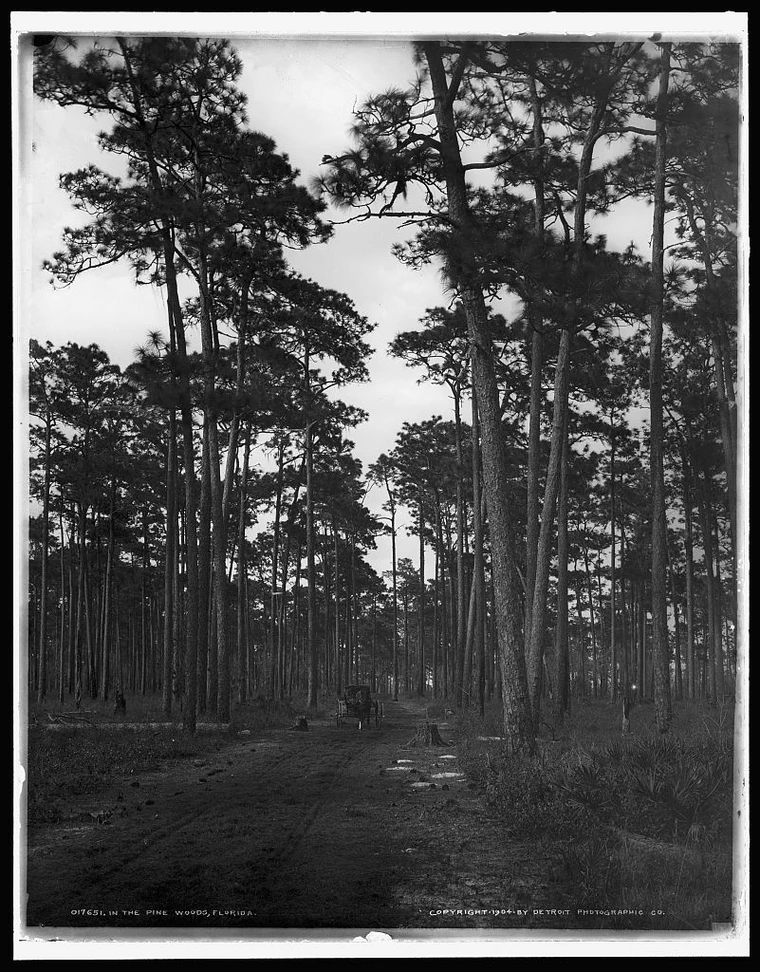
Tall, widely spaced longleaf pines beside a sandy road that runs back into open woods, with a small horse-drawn buggy far down the road.
Southeast Orange County — the whole appeal
What people came out here for. Open, sandy pine country with room to spread out in every direction. “In the Pine Woods, Florida,” Detroit Publishing Co., 1904; Library of Congress. A representative Central-Florida scene of the era.

Drive southeast out of Orlando and the city gets shinier right before it stops. Lake Nona rises out of the flatwoods looking like a rendering somebody actually went and built — a chrome dog the size of a pony on the corner, a hotel with a wave in its name, signs pointing you toward rocket launches and a tennis campus and a medical school. They call it a Medical City. It is about the most planned-out ground in Florida.

And then, a few minutes farther on, it just… ends. The six lanes narrow to two. The sidewalks quit. You’re suddenly between two big lakes with a wall of pine and palmetto on both sides, mailboxes set a long way apart, and somebody’s got a horse.

This is Lake Mary Jane. It has looked more or less like this the whole time — while Orlando grew up a few miles to the northwest, while the theme parks went in, while the Medical City got dreamed up next door. The question is how a place holds still like that. And the answer is the plainest thing in the world. There was room.

A modern planned-city street: a large white building with a colorful patterned facade reading Lake Nona, a mirror-polished chrome dog sculpture on a corner, young palms, directional signs to a performance club and hotel, and an SUV on a wide empty road.
The neighbor, built last Tuesday
What’s a few minutes up the road. Lake Nona Town Center — the shopping-and-rendering heart of the planned “Medical City” that now sits right beside this old country. Lake Nona Town Center, 2024 (modern photograph); PoultrySaga, via Wikimedia Commons (CC BY-SA 4.0).

The lake with the wrong name

Here’s a small thing that tells you how little anyone was watching out here. Pull up the official 1890 map of Orange County, the one the county surveyor drew from his own fieldwork, and find the two lakes where Lake Mary Jane sits today. The western one is labeled Lake Hart, same as now. The eastern one — the one everybody calls Mary Jane — he labeled Lake Fries.

Detail of an 1890 hand-drawn county survey map showing two adjacent lakes labeled Lake Hart and Lake Fries, surrounded by a township grid, green marsh symbols, and the range markings R.30, R.31 and R.32 above a county boundary line.
“Lake Hart” & “Lake Fries” — 1890
The mapmaker put his own name on it. The two lakes that now cradle Moss Park — and the eastern one, today’s Lake Mary Jane, drawn here as “Lake Fries,” after the surveyor himself. Detail from “Map of Orange County, Florida, from Actual Surveys,” J. O. Fries, County Surveyor, 1890; Library of Congress, Geography & Map Division.

Fries was the surveyor’s own last name. He was out here measuring empty townships, and he hung his name on a lake. You don’t do that to a lake people are living around. You do it to a lake at the far edge of the county that nobody’s going to argue with you about.

When “Fries” became “Mary Jane,” and who Mary Jane was, the records I could find don’t say. But the name on that map is the point: in 1890 this was the kind of place a man could rename on a whim, because almost nobody was out here to care. What they were out here doing, when they were out here at all, was using the room.

What you did with all that room

First you bled the pines. The flatwoods that covered this whole corner were longleaf and slash pine, and a pine will give you turpentine if you cut it right — a slanting gash in the bark, a cup underneath, the raw gum scraped out and boiled down to turpentine and rosin at a still out in the woods. The naval-stores men worked their way across southeast Orange doing exactly that.

A Florida turpentine still in the pines: a tall open-sided wooden still shed with vats and barrels underneath, a worker rolling a barrel at left, and a round wooden water tower on tall legs at right.
Boiling the pines down
The first thing the woods were worth. A Florida turpentine still — the kind of still that stood out in the pine country, boiling raw gum into turpentine and rosin. “The turpentine still of the Southern Rosin and Chemical Co. at Pinetop, Florida,” Leland J. Prater, U.S. Forest Service, circa 1944; Wikimedia Commons. A representative Florida still, not Lake Mary Jane itself.

The slash they left is called a catface — a scarred-over wound that fans up a pine like a cat’s whiskers. There are pines on the Moss Park trails right now wearing one. A hundred years on, the tree healed around the cut and kept growing, and the cut is still there to read.

Then you grazed it. Between the lakes and the marshes was open range, and open range in Florida meant cattle — scrub cows left to wander the palmetto, worked by men on little marsh ponies who cracked whips to move them. The cattle came first and the fences came much, much later.

A painted illustration of a lean Florida cattleman in a wide hat sitting a pale marsh pony, a dog at the horse's feet, cabbage palms and palmetto scrub behind him under a gray sky.
Open range, scrub cows
The second thing the land was worth. A Florida open-range cattleman and his marsh pony in the palmetto — the kind of rider who worked the scrub cattle across country like this. Frederic Remington, “A Cracker Cowboy,” 1895; Wikimedia Commons.

And where the ground sat up high and sandy and drained, you planted oranges. The grove wanted exactly what this ridge-and-lake country had: high spots that shed the frost and sat above the water. Groves, cattle, a turpentine lease — a family could run all three off one piece of ground if the piece was big enough. And out here, it always was.

Straight rows of orange trees heavy with ripe fruit running back toward a lake and a pale sky, in tinted color.
Oranges on the high, dry ground
The third thing, on the best ground. Citrus wanted the high, sandy, frost-draining spots above the lakes — the same high ground the homesteads were built on. A Florida grove heavy with fruit, “Lake Region, Florida,” Detroit Publishing Co., 1908; Library of Congress. A representative Central-Florida grove.

So people built what the place needed, out on the ground they had. A packing shed for the fruit. A second little house out back for grown kids, or for a grove hand, or for whoever was helping run the cattle that season. The room out back wasn’t a yard to look at. It was where the next useful thing went.

A small rustic log cabin with a wood-shake roof and a tall stick-and-mud chimney, a palm and pines beside it, and a figure in the doorway.
A second little house out back
Build what you need where there’s room. A Florida homestead cabin of the kind raised out back as a grove-hand’s house or a place for family. “Old Cabin at Turkey Creek,” Detroit Publishing Co., 1880; Library of Congress. A representative Florida homestead, not Lake Mary Jane itself.

Fifty-one acres, given away

In 1928 a couple named Mary and Marcellus Moss did something with their room that almost nobody does. They gave fifty-one acres of it away — the strip of high ground between Lake Hart and the lake on the Fries map — and handed it to the county for a park.

They named it for their daughter Frances, who had died. That’s the whole recorded reason. A grieving mother and father took the best piece of shoreline they had and turned it into a place other families could camp and fish and swim, with their girl’s name on it. People have been pulling boats up on that neck of land ever since.

The gift stayed small for a long while. Then in 1975 another family, the Diamonds, sold the county roughly fifteen hundred more acres around it, and the little memorial park swelled into the biggest park Orange County owns — a wild slab of pine and oak and marsh between the two lakes, nearly twice the size of Central Park, sitting out past the edge of everything.

Out here the room was never the view. It was the asset — the thing you built your whole life on top of.

The room becomes the rare thing

For most of a century, being this far out was the catch. No city water, no sewer, a long drive to anywhere, the lake with the surveyor’s leftover name. That’s exactly why the lots stayed big and cheap and why the families who wanted elbow room came and got some.

Then Orlando kept coming. The airport went in to the north. Lake Nona’s Medical City landed to the west with its hospitals and its chrome dog. And all of a sudden the thing that had made this corner a backwater — all that undeveloped room — was the scarcest, most valuable thing for miles.

You can feel the squeeze in the fight over Split Oak Forest, the wild preserve on the lake’s southwest side, where a deal to run new rooftops and a road into protected land has been argued over for years. When the open ground runs low, every acre of it is suddenly worth fighting about. Room stopped being the thing nobody wanted and became the thing everybody’s after.

A wild Florida oak hammock: broad live oaks draped heavily in Spanish moss above a dense green understory of saw palmetto and dry wiregrass, under a pale overcast sky.
What the fight is over
The room, still standing. Live oak, Spanish moss, and saw palmetto in Split Oak Forest, the preserve on the southwest shore of Lake Mary Jane. Split Oak Forest, 2024 (modern photograph); via Wikimedia Commons (CC BY-SA 4.0).

And yet the old habit held. Drive the lake today and you’re on big lots again almost at once — the Isle of Pines, Live Oak Estates — places where a house still sits on a couple of acres, where there’s often no HOA telling you what to do with the back of your property, and where the person down the road keeps horses the way their predecessors kept cattle. Moss Park is bigger than it’s ever been. The catfaced pines are still on the trail. Frances Moss’s neck of land is still handing out boat ramps.

So you come off Lake Nona Boulevard, past the mirror-finish dog and the hospital towers, the road narrows, and there’s the horse. The chrome city and the cattle country are neighbors now, close enough to see from each other. What the old corner kept, the one thing it never gave back, is the thing the shiny new one is running out of. It kept the room.

A present-day note · Orange Tiny Homes

The room out back is still the best thing on the lot.

Lake Mary Jane was settled on one plain rural-Florida habit: when you’ve got ground, you put something useful on it. The homesteads out here ran groves and cattle and a turpentine lease, and built a second little house out back — for grown kids, for a grove hand, for whoever needed a roof that season. The room out back was never decoration. It was where the next thing went.

That instinct still pays, and these days the thing people build out back has a name — an ADU, an accessory dwelling unit — and it’s what we build. A granny flat so a parent can live close with their own front door. A guest house. A rental out back that helps carry the mortgage. A tiny home on the far corner of the lot. Same idea those big Lake Mary Jane lots were settled on, just with a kitchen, a bathroom, and a permit.

And you don’t need acreage on the lake to do it. Across greater Orlando — the roomy lots out by Lake Mary Jane, the Isle of Pines and Live Oak Estates, sure, but also ordinary yards in Conway, Meadow Woods, Azalea Park and Pine Hills — plenty of homes already have the space. What actually decides it comes down to your own address:

The real answer to “is there room out back for this?” isn’t a guess — it’s a handful of facts about your lot. That part we can check for you.

Put in your address and we’ll pull what your parcel allows and tell you whether a granny flat, guest house, rental, or tiny home actually fits — before you spend a dollar on drawings.

Start the ADU Fit Check→
Sources & Photo Credits

On the history

Lake Mary Jane survives in county park records, a 2025 Orange County article on Moss Park, current real-estate descriptions of the big-lot settlements, and the 1890 county survey — not in a deep photographic archive of the place itself. Of the images below, only the 1890 map and the two 2024 photographs (Lake Nona Town Center and Split Oak Forest) are of this specific area. The turpentine still, the Cracker Cowboy, the orange grove, the pine woods, and the homestead cabin are each identified in their captions as representative period Central-Florida scenes standing in for the turpentine, cattle, citrus, and homestead work described here. The “catface” scar on a Moss Park pine and the one-acre/two-acre lot descriptions come from the county and real-estate sources above. Full notes are in source-record.md beside this page.

Photographs & maps

  1. In the Pine Woods, Florida (hero) — open longleaf-pine high ground with a sandy road; Detroit Publishing Co., 1904; Library of Congress. A representative regional scene of the open country. File: florida-pine-woods-1904. loc.gov
  2. Lake Nona Town Center — the planned “Medical City” retail center with its colored facade and the mirror-finish “Disco Dog” sculpture; 2024 (modern); PoultrySaga, via Wikimedia Commons (CC BY-SA 4.0). File: lake-nona-2024. source
  3. Map of Orange County, Florida, 1890 (detail) — Lake Hart and “Lake Fries” (today’s Lake Mary Jane) with the township grid and the Osceola County line; J. O. Fries, County Surveyor, 1890; Library of Congress, Geography & Map Division. File: fries-map-lakes-1890. loc.gov
  4. Turpentine still, Pinetop, Florida — a Florida naval-stores still shed with vats, barrels and a wooden water tower; “The turpentine still of the Southern Rosin and Chemical Co. at Pinetop, Florida,” Leland J. Prater, U.S. Forest Service, circa 1944; Wikimedia Commons (PD-USGov). Shown as a representative Florida still (the mounting and typed caption are cropped out). File: turpentine-still-1944. source
  5. A Cracker Cowboy — a Florida open-range cattleman on a marsh pony in the palmetto; Frederic Remington, 1895; Wikimedia Commons (PD-US). File: cracker-cowboy-1895. source
  6. Florida orange grove (“Lake Region, Florida”) — a grove heavy with ripe fruit beside a lake; Detroit Publishing Co., 1908; Library of Congress. A representative Central-Florida grove. File: florida-orange-grove-1908. loc.gov
  7. Old Cabin at Turkey Creek — a Florida frontier homestead cabin; Detroit Publishing Co., 1880; Library of Congress. A representative Florida homestead, not Lake Mary Jane. File: florida-cracker-cabin-1880. loc.gov
  8. Split Oak Forest — live oak, Spanish moss and saw palmetto in the preserve on the southwest shore of Lake Mary Jane; 2024 (modern); via Wikimedia Commons (CC BY-SA 4.0). File: split-oak-forest-2024. source

Original downloads and a full research record are kept alongside this page in assets/images/originals/ and source-record.md. The orange grove and pine-woods prints are tinted period images; no historical image was altered in any way that changes its content. The Polaroid frames and handwritten notes are CSS added around the images, never onto them. The 1890 map and the turpentine still are shown as cropped details; the full originals are preserved.