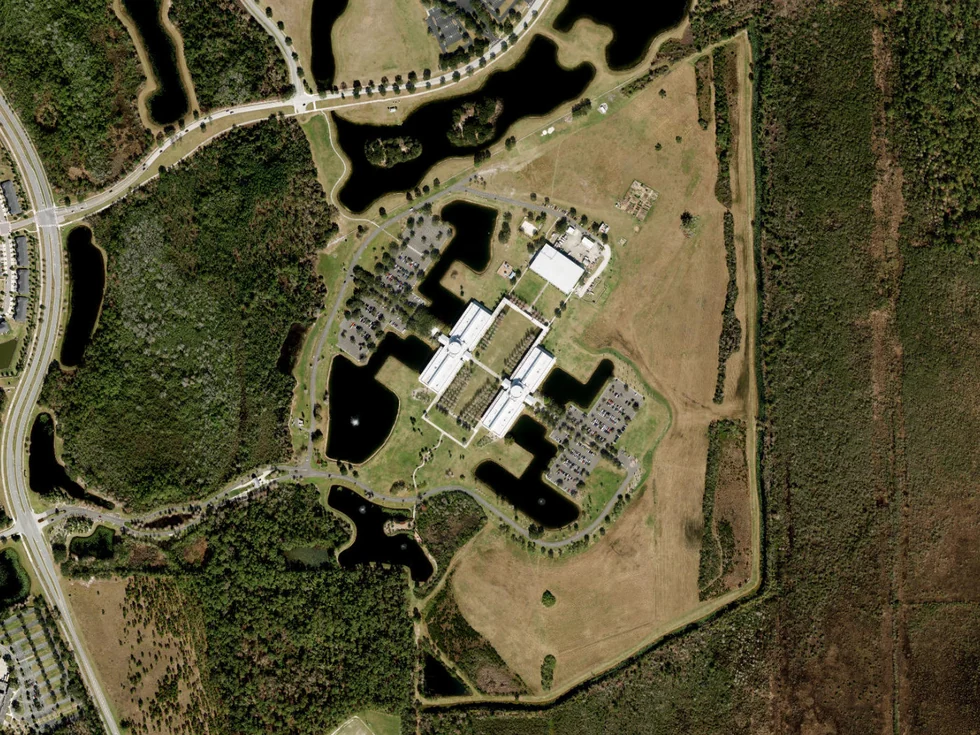
Drive southeast out of Orlando — past the airport, past the last of the new subdivisions — and the land starts to open back up into something close to what it looked like a century ago: flat, green, more water than road. Then, out in the middle of it, a campus. Not a strip mall, not a warehouse. The world headquarters of one of the largest Christian organizations on the planet, sitting on a few hundred acres that were cattle pasture within living memory. The address is 100 Lake Hart Drive. Standing there, the obvious question is: why here?
The short answer is the same one this corner of Orange County has been giving for a hundred and fifty years. There was room.
The far edge of everything
Lake Hart sits about twenty miles southeast of downtown Orlando, out where Orange County runs down to the Osceola line. For most of its history that distance was the whole point of the place — it was far. Too far out to be worth much, which is exactly what kept it open.

This was open-range cattle country. Before Florida fenced its herds, cattle wandered loose across the flatwoods, and men on marsh ponies — “cow hunters” — rode out to gather them from the palmetto and the lake edges. On the higher, drier ground, people set out citrus. Between the two, the land stayed mostly as it had always been: pine, palmetto, scrub, and a lot of shallow water.
Who was Hart?
Nobody wrote down for certain who Lake Hart was named for — a lot of these Central Florida lake names lost their stories a long time ago. But the oldest good map of the county, drawn from actual surveys in 1890, leaves a clue.

On it, the lake is already labeled Lake Hart, with little Lake Barton tucked against its northwest side — you’ll find that one on today’s maps as Lake Whippoorwill — and Lake Fries to the east, the lake we now call Lake Mary Jane. And just up the road from the north shore, the surveyor inked a single homestead: a small black square, lettered E. Hart. The record doesn’t say more than that. But there’s the name, sitting right where the lake got it.
You built what you needed
Out here, having room wasn’t scenery. It was the whole way of living. When your nearest neighbor was a half-mile off and the nearest town was most of a day away by wagon, you didn’t run into town for things. You built them.

A main house. A detached kitchen set a little apart, so the cookstove wouldn’t take the house with it on a hot July afternoon. A barn, a smokehouse. And often a second little dwelling out back — for the grown kids, for aging parents, for the hand who helped work the grove. The habit was simple: when you’ve got ground, you put the next useful thing on it. Hold onto that one; it comes back at the end.
A mountain resort trades places with a cow pasture
Campus Crusade for Christ was founded in 1951 by Bill and Vonette Bright, on the campus at UCLA. For three decades its headquarters sat about as far from Lake Hart as you could get and still be in the country: Arrowhead Springs, a grand mineral-springs resort hotel in the hills above San Bernardino, California.

By the late 1980s the organization had outgrown the mountain and gone looking for somewhere new — central to the country, cheap to build on, easy to fly in and out of. Orlando, with its airport and its miles of open, affordable land, checked every box.
What it found was 285 acres on Lake Hart — room enough to lose a small town in — out past the airport, where the price of an acre still made sense. The county helped the deal along with a promise of road money, a couple of million dollars’ worth. The move was made in 1991, and the big campus — a complex you could set down in a downtown and call a civic center — was dedicated out on the old pasture in 1999.
“We feel strongly that God led us to Orlando, and we’re glad he did,” the organization’s founder said at the time.
Whatever led them, the practical fact was the one Lake Hart had been offering all along: space to build something big, right next to good roads, without paying city prices for it. The empty corner finally got used. Its cow-pasture address became 100 Lake Hart Drive, and the organization itself, years later, shortened its name to simply Cru.
The room keeps getting spent
Once the far edge of the county turns out to be reachable, it doesn’t stay empty for long. The same open land that drew a world headquarters also drew the planned city next door.

As recently as 2012, the site of Lake Nona’s “Medical City” — the hospitals and research campuses a few minutes west — was still open field with cattle standing in it. You can watch a hundred years go by fast out here: cow range, then a headquarters, then a whole engineered town, all on ground that was “too far out” within a single lifetime.
What’s still here
And a lot of the old character held on, because there was enough of it to go around. Moss Park, the county park on the neck of land pressed right against Lake Hart’s shore, still looks the part — live oaks dragging Spanish moss, black water, the kind of quiet you have to drive a while to reach.

Stand at the water there and you can take in the whole thing at once: the lake still carrying its pioneer’s name, a shoreline nobody ever got around to clearing, and — a couple of miles up the road — a world headquarters parked on what used to be somebody’s cattle range. Same corner, same reason it all ended up here. There was room, and out here somebody always turns up with the next use for it.


