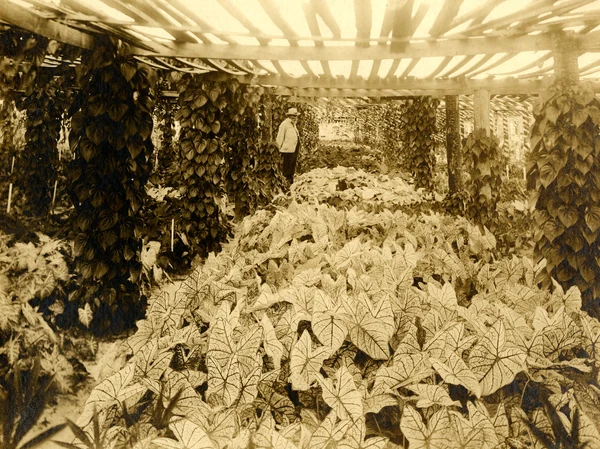
Long before anybody drove to Orange County to see a mouse, they drove out to see a garden. Not a public park. Not a tourist nursery. A private backyard, behind a wooden cottage, in a little German farm colony called Gotha that most people in Orlando couldn't quite find on a map then and couldn't now.
The man who owned it was not a farmer or a developer. He was a bird expert from Milwaukee with weak lungs and a good notebook, and the thing he planted on the acreage out back ended up changing what the whole state looks like. That hand-painted red-and-green caladium leaf you have seen in a hundred Florida planters, the one that looks almost too bright to be real, traces straight back to the room behind his house.
So here is the question this place answers, if you let it. How does a backyard, in a town nobody has heard of, become the first thing people in Central Florida bragged about seeing?
The bird man who came south

His name was Henry Nehrling, and his first fame had nothing to do with plants. He ran the public museum up in Milwaukee and wrote a thick, beautiful book on American songbirds, the kind with color plates people cut out and framed. Birds were the whole thing. Then his health and a Florida land boom pointed him south, and in the mid-1880s he bought a piece of ground in Gotha, a colony of German freethinkers who had come to grow oranges on the high sandy ridge west of Orlando.
He meant it as an orange grove and a place to rest his lungs. He got a laboratory instead.

What changed him was a single afternoon at a world’s fair. In 1893 Nehrling went up to Chicago for the great Columbian Exposition, the one with the white domes along the lagoon, and he wandered into the Horticultural Building to get out of the crowd.
The leaf he couldn’t put down

Inside, under glass, were tropical plants nobody up north had ever seen, and one of them stopped him flat. It was the fancy-leaved caladium from Brazil, a plant grown for nothing but its leaf, and the leaves came in reds and pinks and whites, veined and splashed like a piece of stained glass. A plant that looked like a flower all over, year round.
He had to have them. Through a dealer with South American connections he got hold of hundreds of Brazilian caladiums, and he carried that one obsession home to the sandy acre behind his cottage in Gotha.

What he built on that ground, over the next thirty years, became one of the first real plant-testing gardens in the state, and the federal government leaned on it. He would grow out something odd from the far side of the world, bamboo from China, amaryllis, a palm, a leaf nobody had dared in this soil, and watch what lived through a Gotha summer and what the cold took in winter. Something like three thousand kinds of plant passed through his ground. A few hundred of them stuck, and quietly became the ordinary furniture of Florida yards.
The caladiums ran away with him. At the top of it he had something close to seventeen hundred named kinds of them growing under a lath house, a long shed roofed in wooden slats so the sun would not scorch the leaves, the floor below one solid quilt of color. That is the room at the very top of this page.
Word got out

A thing like that does not stay quiet for long. Plant people started making the trip out to Gotha the way you would make a pilgrimage, and the names got large. David Fairchild, the government’s great plant explorer, came to see it. Liberty Hyde Bailey, about the most important garden writer in the country, came. By the account the place keeps on itself, Theodore Roosevelt turned up at the gate too. For a stretch of years the most talked-about address in Orange County was a cottage at the end of a dirt road, in a German farm colony, and the attraction was a man’s backyard.
The most famous address in the county was a backyard at the end of a sand road.
Then the cold came for it

Florida has a way of settling accounts with anyone who gets comfortable growing tender things. A hard freeze in 1917 came down the peninsula and took most of it, the tropical collection Nehrling had spent decades pulling together, gone in a couple of nights.
So he did the thing Florida growers have always done after a freeze. He went farther south. He started a second garden down near Naples, on the bet that the cold simply could not reach that far, and moved what he could save. That southern garden outlived him, too. It is the Naples Zoo now.
The leaf outran the man

Nehrling died in 1929, and you would expect a private garden in a town nobody has heard of to die with him. The garden nearly did. The leaf did not. The caladium he dragged home from a world’s fair turned into a Florida crop, then a Florida industry. Nearly every caladium bulb sold in this country is now grown a couple of hours south of Gotha, around a town called Lake Placid that calls itself, without much argument from anyone, the caladium capital of the world. The thing one man was obsessed with in his backyard is now a thing people grow by the field.
What’s still out there

The heart of it survived. A few acres of Nehrling’s ground, the old cottage and the oldest of his trees, are still there on Hempel Avenue in Gotha, kept up as a historic garden you can walk through on an afternoon. It sits in the same small community that Lake Crescent Reserve belongs to, on the same high sandy ridge, carrying the same old habit: a generous piece of ground, with room out back to try something on.
Which is the quiet point of the whole story. The first famous thing in Orange County was not a building, or a beach, or a ride. It was what one stubborn man did with the room behind his house. He had the ground, so he filled it with the thing he could not stop thinking about, and people drove out to a dirt road in Gotha to see it.


_Vent.);_3_large_stalked_l_Wellcome_V0042685.jpg)
