Stand at the edge of Lake Cawood Cove and the newest thing in sight is the asphalt. The houses are a few years old, the lawns are irrigated, the lots are drawn in tidy rectangles. For most of the time Orange County has existed, none of that was true, and the single strangest fact about the ground under those lots is this one: a cow had more claim to it than the person who owned it.
That is not a figure of speech. Under Florida's old open-range law, if your land was not fenced, a roaming cow grazing across it was doing nothing wrong. The burden was on you. You fenced your garden to keep the cattle out. Nobody fenced cattle in, because the whole country was one shared pasture and the cattle belonged to whoever had branded them.
So the question this place answers, if you let it, is a simple one. How did a square of open range that belonged to everybody's cows turn into a backyard that is unmistakably yours? The answer runs through a cattleman, a magazine artist, and one law that made Florida the last holdout in the country.
Orlando was a cow town before it was an orange town

The man usually called Orlando's first settler was not a grower. He was a cowman. Aaron Jernigan rode down from the Tallahassee country in 1843, took land on the shore of Lake Holden under a federal act that handed acreage to anyone willing to settle the frontier and defend it, and he brought something like seven hundred head of cattle with him.
The little settlement that grew up around his place took his name. For years the spot that is now downtown Orlando was called Jernigan, after the cattleman, on the strength of his herd. The oranges that the whole region would later be named for came afterward. The cows came first.
And Jernigan was not unusual. He was the local version of a type that ran the whole peninsula. Men like Jacob Summerlin owned barely-improved homesteads but grazed cattle by the tens of thousands across country nobody had fenced, drove them to the coast, and shipped them to Cuba for Spanish gold. The wealth of early Florida walked on four legs and ate wiregrass, and it did it on land that was, in the practical sense, held in common.
The men who worked it had whips, not lassos
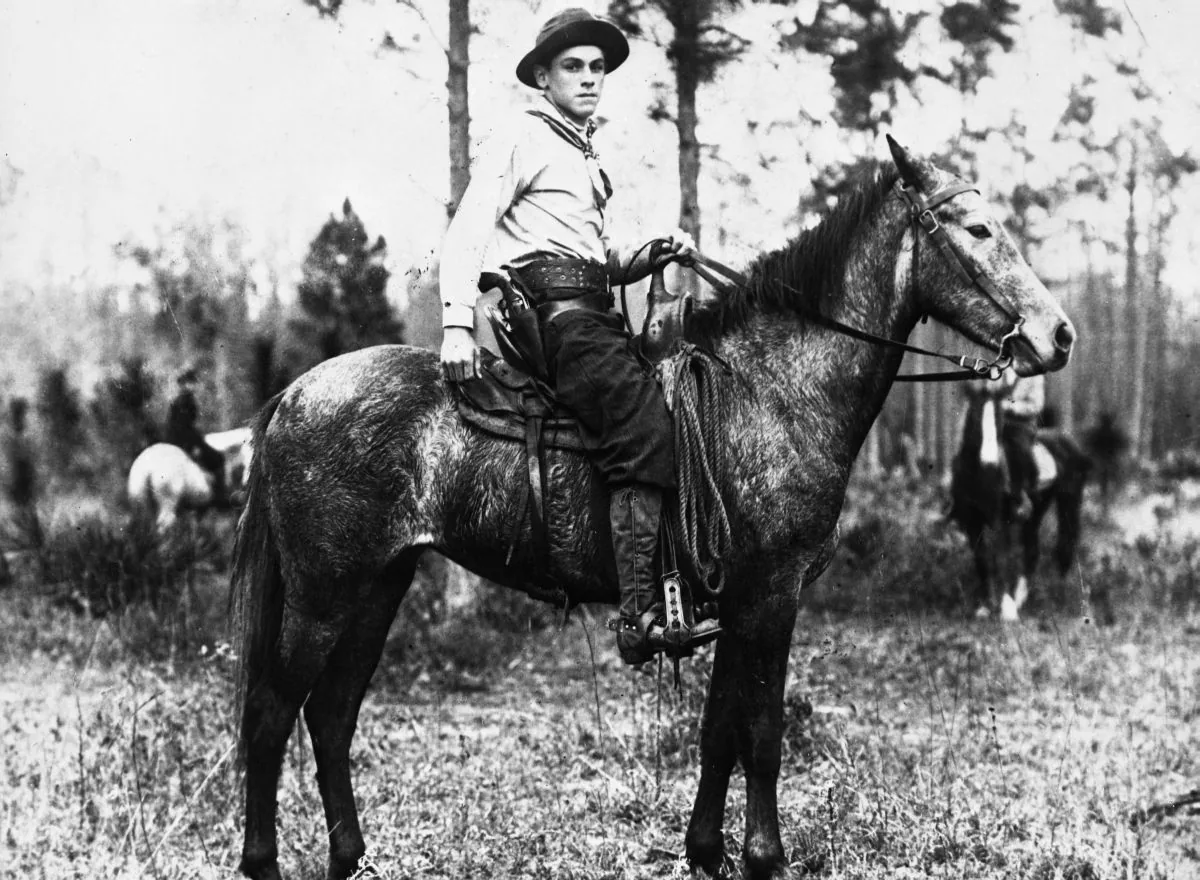
In 1895 a famous magazine artist named Frederic Remington came down to see these Florida cowmen for himself. He had made his name drawing the cowboys of the western plains, all open sky and lariats, and what he found here plainly unsettled him. He wrote it up for Harper's with his own drawings, and the Florida cow hunters came out looking nothing like the romantic figures up north.

They did not rope cattle. They drove them out of the palmetto with long braided cowhide whips that cracked like a rifle shot, and that sound is where the word came from. A Florida Cracker, at the root of it, is somebody who cracks a whip over cattle in the scrub. Remington called them a hard, lean lot, and he did not entirely mean it as a compliment.

A palmetto shelter and a cook fire was about the most anybody built on it; the land itself stayed open. And because they all worked that same shared ground, the only thing that said which cow was whose was the brand burned into its hide. There were no fence lines to sort the herds, so a man's wealth was a mark, not a boundary. Old Spanish brands, carried down from the cattle the first Spaniards had turned loose centuries before, were still being logged in Florida well into the twentieth century.


It was a workable system right up until two cattlemen claimed the same unbranded calf, and then it was not workable at all. Remington came home with stories of ambushes and shootings over stolen stock, and his drawings leaned hard into it, men waiting in the brush, men fighting over a herd. Shared ground has that built into it. When the fence is nowhere, the argument is everywhere.

The drive, and the thing that killed it
Twice a year the cowmen gathered the loose herds off the range, cut out what was theirs by its brand, and drove it across the flatwoods and down the sand roads toward the pens and the railheads. A drive crossing a road, or coming right down the middle of a small town, was an ordinary sight. The road belonged to the cattle about as much as to anyone.

Then the roads changed. Sand got paved, and the thing coming down the pavement was no longer a wagon at walking speed but a car at forty miles an hour. A loose cow and a Buick met badly, and by the 1940s they were meeting often. A cow asleep on warm asphalt after dark could kill a family and total the car, and the cattleman, by the old rule, owed nothing. The animal had the right of way.
That is what finally broke a system that had held for a hundred years. Not sentiment, not progress. Insurance claims and funerals on the state highways.
1949: the year the line got drawn

In 1949 Governor Fuller Warren signed the bill that ended it. From then on, the burden flipped. A cattleman had to keep his animals off the public roads and fenced onto his own ground, and if they got out and caused a wreck, he answered for it. Florida was the very last state in the union to pass a law like that. The open range had outlived every other version of itself in America, and here is where it finally closed.
It sounds like a traffic measure. It was really a land measure. Overnight, “my land” stopped being a brand on a wandering animal and started being a fence around a piece of ground. The commons became lots. Every cattleman out here ran a line around what was his, and a hundred years of shared Florida quietly turned into private Florida, parcel by fenced parcel.
The fence did not just hold the cattle in. It drew the backyard.
The room was always the point
So go looking for the open range around Windermere and you will not find a trace of it in the obvious way. The scrub is lawns now, the cow hunters are a historical marker, the whips are in a museum. What you find instead is the shape the fences left: big, roomy lots, a habit of ground with space around the house, the direct descendant of a country where land came by the hundreds of acres because that was the only size cattle made sense in.
That habit outlasted the cattle the way it outlasted the groves that came after them. The crop on the land kept changing, from scrub cows to orange trees to houses, but the instinct underneath never did: out here, you get a generous piece of ground and you spread out on it. The subdivisions off Winter Garden Vineland Road sit on land that was measured for herds, and a lot of that old roominess is still sitting in the yards.
A cow really did once have the right of way across this ground. What changed in 1949 was not the land. It was whose it plainly was. And once it was plainly yours, the only question left was what you would put on all that room.


