Lake Butler Sound, Orlando, Florida  ·  A Local History

When Versailles Came to a Lake in Florida


On a gated shore near Windermere, a timeshare king set out to build the biggest house in America and named it after a French palace. Then the money froze. It’s the oldest impulse this corner of Florida has. Get a piece of ground with room, and build. Taken about as far as it will go.

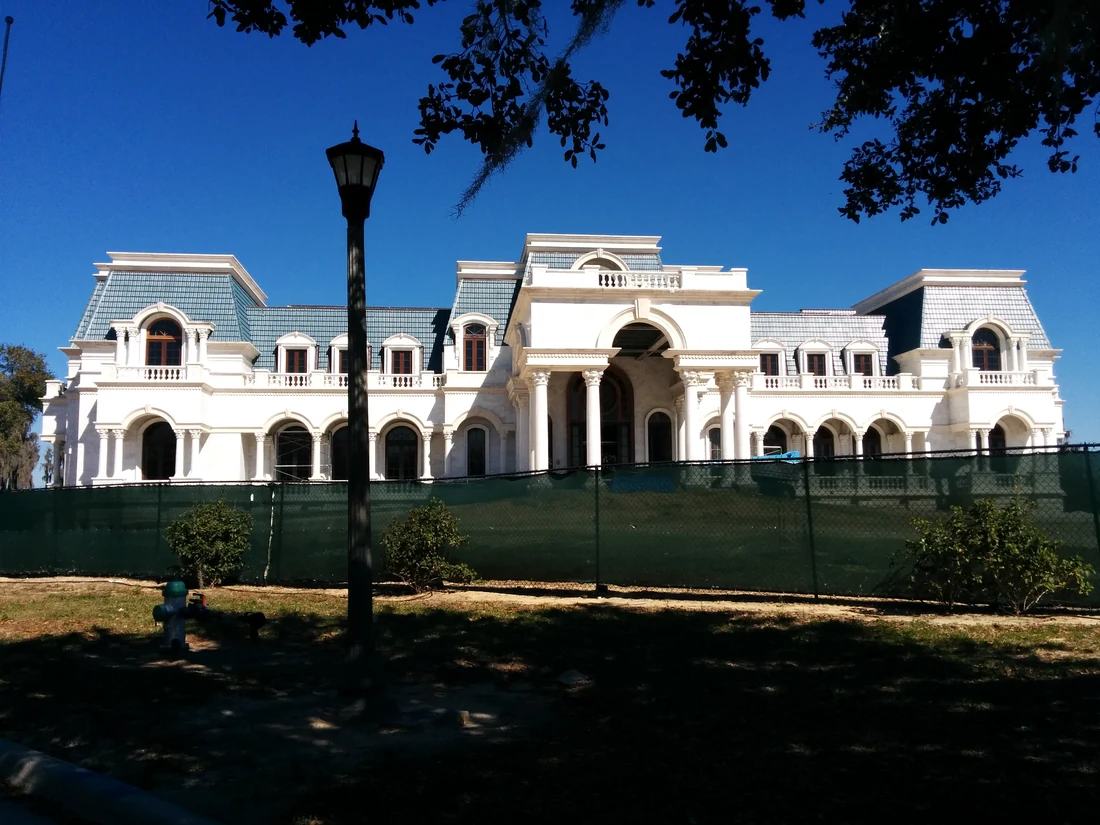
A vast half-finished stone mansion with a central dome and tall arched windows rises behind a chain-link construction fence, its pale walls weathered and its grounds still bare dirt.
The biggest house in America, still going up
Behind the fence on Lake Butler Sound. The Siegel house near Windermere, Florida, photographed mid-construction, a 90,000-square-foot home modeled on the Palace of Versailles. Via Wikimedia Commons.

There’s a guardhouse off a quiet road near Windermere, on a gated shore called Lake Butler Sound, and behind it is a house that has been not-quite-finished for more than twenty years. It is enormous, the kind of enormous you can’t take in from the ground. If it ever gets a certificate of occupancy, it will be, by most counts, the largest single-family house in America. The people who built it named it Versailles, after the palace outside Paris, and they meant it.

So here’s the thing a normal person wonders driving past that fence: who decides they need a house that big, and why on earth would they put it here, on a lake in Orange County?

Ninety thousand square feet of “more”

Start with the scale, because the scale is the whole personality of the thing. The plans call for about 90,000 square feet under roof. Fourteen bedrooms. A ballroom meant to hold up to a thousand people. Three indoor pools. A bowling alley. And, the detail that sticks with you, thirty-two bathrooms, which is more toilets than most Florida subdivisions start with.

It was modeled on an actual French palace. Not “palace-inspired” the way a builder slaps columns on a tract home. The owners went to Versailles and the top of the Paris Las Vegas casino and came home wanting both, at full size, on their own lakefront. A dome. A grand staircase. A master suite bigger than a nice house all by itself.

The long gilded stone facade of the Palace of Versailles in France, rows of tall windows and steep slate roofs stretching across a formal paved courtyard under a pale sky.
The thing they were copying. Versailles, France
The original. The Palace of Versailles outside Paris, built for a king who also wanted the biggest house anyone had ever seen. The Florida house takes its name and its ambitions from this one. Modern photograph, via Wikimedia Commons.

You don’t build that by accident, and you don’t build it on a teacher’s salary. So where did the money come from?

The timeshare king

From selling people a week. David Siegel started a resort company called Westgate in the early 1980s with a single small building, and he turned it into the largest privately held timeshare operation in the world, the business of selling a few days a year of a Florida vacation to a few hundred thousand families at a time. It is a machine that runs entirely on confidence and credit, both the buyer’s and the company’s. When money is cheap and everybody feels rich, it prints.

A tall cream-colored resort tower with rows of balconies and palm trees out front, a Westgate timeshare building in the Orlando area under a blue sky.
Where the house came from, a week at a time
The engine. A Westgate Resorts timeshare tower in the Orlando area. Selling a few vacation days to hundreds of thousands of families built the fortune behind the house. Via Wikimedia Commons; a representative Westgate property.

Ground broke on the house in 2004, right at the top of the boom. For a few years the money was there and the walls went up fast: the dome, the frame, the bones of a palace on the lake. And then, in 2008, the confidence the whole business ran on simply evaporated.

A grove dies in a freeze because the fruit can’t wait. This house stopped for the same reason. The money that fed it froze overnight, and a half-built thing can’t wait any better than an orange can.Why it stalled

The winter the money froze

When the credit markets seized in 2008, Westgate’s lines of financing seized with them. A company that sells tomorrow’s vacations needs today’s loans to keep the lights on, and suddenly the loans were gone. There were layoffs, surrendered properties, a scramble to survive. And the house on the lake just… stopped, somewhere around sixty percent done, a vast gray shell behind a fence, rooms roughed in and open to the weather.

For a while they put it up for sale. Finished or not, the biggest house in America, yours for around sixty-five million dollars. Nobody who wanted it that badly turned up, and the family decided to keep it and finish it themselves, slowly, out of pocket, as the business clawed back.

The unfinished front of the mansion seen across a bare dirt yard, gray unpainted walls and empty window openings, construction materials scattered on the ground.
The stall, a shell in the weeds
What “stopped” looks like. The house during the long pause, gray walls, open window holes, a dirt yard, after construction halted around 2009. Via Wikimedia Commons.

That pause is how most people first heard of the place. A documentary crew had started filming the family while the house was going up, expecting a story about building a palace; what they got instead was a story about the floor dropping out. The film came out in 2012 and it gave the family a nickname that stuck better than their own: the Queen of Versailles, and her unfinished castle.

The man who never got to live in it

The finishing took a very long time. Stop, start, stop again. More than twenty years after that first foundation permit, the inside is finally mostly done: the ballroom, the kitchens, the ten-thousand-square-foot master suite, the four-thousand-square-foot closet. By 2026 the work left is mostly the outside: the pools, the stonework, the landscaping on ten acres of lawn.

A posed studio portrait of Jackie Siegel, a blonde woman in a formal gown, the subject of the documentary that nicknamed her the Queen of Versailles.
The one who kept building
The Queen of Versailles. Jackie Siegel, who carried the house through the stall and the long finish and now means to turn it toward charity events. Portrait by Philip Romano, via Wikimedia Commons.

David Siegel died in April of 2025, at eighty-nine, with the house still not signed off. His wife has said they wheeled him through the nearly finished rooms a few weeks before the end, so he could see the boys had taken over and gotten it this far. He was proud of it. He never got to live in it. The biggest house in America outlasted the man who wanted it, which is a very old story told in a very new building.

His widow says the plan now isn’t really to live in all of it either. It’s to open the ballroom and the grounds for charity galas, with the rental fees waived so more of the money goes to the cause. A palace built as the ultimate private address, ending up as a place you lend out. The room, it turns out, was always looking for a use.

Why anyone wanted room on this lake

Step back from the fence and the thing makes more sense. Lake Butler Sound sits on the Butler Chain, more than a dozen clear lakes stitched together by canals you can take a boat through, the biggest of them well over a thousand acres of open water. People have wanted room on these lakes since long before anyone poured a 90,000-square-foot slab. The house sits on about ten acres with something like twelve hundred feet of its own shoreline. That’s not a yard. That’s a small ranch with a lake for a fence.

An aerial view of the Butler Chain near Windermere: a wide blue lake ringed by green, with large homes spaced far apart on big wooded lots running down to the water.
The Butler Chain near Windermere, room, by the lakeful
What the gate is really protecting. A present-day aerial of the Butler Chain of Lakes near Windermere, big water, big lots, houses spread far apart down to the shore. Via windermerefl.com; a representative modern view of the chain.

Big water is the reason, and it always was. A century ago it was citrus men who prized this ground, because the lakes hold the day’s heat overnight and keep a grove a few degrees warmer when a freeze comes down. The difference between a crop and a ruin. The oranges are long gone. The thing that made the oranges valuable is still right there, lapping at the back lawns.

A calm Butler Chain shoreline at Windermere today, tall palms and shade trees along a grassy bank with open water beyond.
The water that never moved
The actual draw. A Butler Chain shoreline at Windermere today, the open water that made this ground worth having, long before the gates. Present-day photograph, via Wikimedia Commons.

And the habit behind the whole thing is older than the lake houses too. This part of Florida was settled by people who came down, claimed their acres out in the pine and palmetto, and built what they needed on their own ground: a house, then a barn, then a packing shed, then more as the family grew. The county map was a record of people getting room and putting things on it.

An 1890 map of Orange County, Florida: a grid of townships and sections with lakes scattered across the western half and the surnames of landowners printed on their parcels.
Orange County, 1890. The room, carved into names
Room, on paper. A map of Orange County from 1890, townships, sections, the chain of lakes down the west side, and the names of whoever had claimed their ground printed right on their parcels. J. O. Fries, E. W. Smith & Co.; Library of Congress.

Before the guardhouse and the gala plans, this shore was that: low palmetto and water, ground waiting for somebody to want it. A piece of that quiet still survives right next door, in a preserve where a boardwalk runs out into the hammock on the same chain of lakes.

A present-day wooden boardwalk curving through a shaded Florida hammock of oaks and ferns at Tibet-Butler Preserve on the Butler Chain.
The wild edge, still on the chain
What the ground was. The boardwalk at Tibet-Butler Preserve, on the same Butler Chain as Lake Butler Sound, 2016. Via Wikimedia Commons. A modern photograph.

So the biggest house in America isn’t really a break from anything. It’s the oldest local instinct there is, get room, build what you want on it, run all the way to the end of the road, dome and ballroom and thirty-two bathrooms. The lake it sits on doesn’t care how big the house behind it got. Same water that would have saved a grove, same storms that knocked ten million dollars of damage into the place in a single afternoon in 2022. The house is the largest in the country. It still bows to the lake, same as the smallest cottage on the chain.

A present-day note · Orange Tiny Homes

You don’t need ninety thousand square feet. You need the right room out back.

Take the dome and the ballroom off of it and the Versailles house is doing the plainest Central-Florida thing there is: somebody got a piece of ground with room on it and built the thing they wanted. The homesteaders on that 1890 map did it a barn and a back cottage at a time. The timeshare family did it at the scale a fortune will buy. Same instinct, wildly different budget.

And the sane version of that instinct is alive and well on ordinary lots all over Orange County. It just has a smaller, smarter name now. An ADU, an accessory dwelling unit. A granny flat so a parent can live close with their own front door. A guest house. A rental out back that helps carry the mortgage. A tiny home in the far corner of the yard. The Siegels’ move, basically, put what you need on the room you’ve got, minus the thirty-two bathrooms.

And you don’t need a point on the Butler Chain to do it. Out toward Windermere and Gotha, sure, but just as much in plenty of regular yards in Conway, Pine Hills, Azalea Park, Rio Pinar and unincorporated Orange County. The room is already there. What actually decides it comes down to your own address:

The real answer to “is there room out back for this?” isn’t a guess. It’s a handful of facts about your lot. That part we can check for you.

Put in your address and we’ll pull what your parcel allows and tell you whether a granny flat, guest house, rental, or tiny home actually fits, before you spend a dollar on drawings.

Start the ADU Fit Check→
Sources & Photo Credits

On the history

Where figures differ between sources, the page uses round, hedged language rather than pinned numbers: the square footage (about 90,000), the stall completion (about 60%), the listing price (about $65 million), the acreage and shoreline (about 10 acres, roughly 1,200 feet), and the amenity counts are drawn from the Wikipedia and GrowthSpotter accounts above and are reported figures rather than building records. The “largest single-family house in America” claim is widely reported and conditional on the house being completed and on how “single-family house” is counted; it is given on the page as the common claim, not a settled fact. Full notes are in source-record.md beside this page.

Photographs & documents

  1. The Versailles house on Lake Butler Sound (hero), the Siegel house near Windermere, Florida, photographed mid-construction behind its fence. Via Wikimedia Commons. File: versailles-house-lake-butler-sound. commons.wikimedia.org
  2. Palace of Versailles, France, the French palace the house is named and modeled after. Modern photograph, via Wikimedia Commons. Clearly the French original, not the Florida house. File: palace-of-versailles-france. commons.wikimedia.org
  3. Westgate Resorts timeshare tower, Orlando area, a Westgate property representing the company behind the fortune. 2022, via Wikimedia Commons. A representative Westgate tower, not the specific resort referenced in the text. File: westgate-resorts-orlando-timeshare. commons.wikimedia.org
  4. The unfinished house, the Siegel house during the long pause, gray walls and a bare yard. Construction-era photograph, via Wikimedia Commons. File: versailles-house-front. commons.wikimedia.org
  5. Jackie Siegel, portrait of Jackie Siegel, the “Queen of Versailles.” Portrait by Philip Romano, via Wikimedia Commons. File: jackie-siegel-queen-of-versailles. commons.wikimedia.org
  6. Butler Chain aerial, near Windermere, a present-day aerial of the Butler Chain of Lakes with large lakefront lots. Via windermerefl.com; a representative modern view of the chain near Lake Butler Sound. File: butler-chain-aerial-windermere. windermerefl.com
  7. Butler Chain shoreline today, a present-day photograph of a Butler Chain lakeshore at Windermere (Lake Down Park). Via Wikimedia Commons. Clearly a modern image. File: butler-chain-shoreline-today. commons.wikimedia.org
  8. Map of Orange County, Florida, 1890, townships, sections, lakes, and landowners’ names, drawn by J. O. Fries and published by E. W. Smith & Co., Philadelphia, 1890. Library of Congress Geography & Map Division, via Wikimedia Commons. File: orange-county-map-1890. loc.gov/item/2012592407
  9. Tibet-Butler Preserve boardwalk, 2016, a present-day photograph of the boardwalk at Tibet-Butler Preserve on the Butler Chain. Via Wikimedia Commons. Clearly a modern image. File: tibet-butler-boardwalk-today. commons.wikimedia.org

Original downloads and the full research record are kept alongside this page in assets/images/originals/ and source-record.md. The Versailles-house photographs are genuine images of the real house on Lake Butler Sound; the Palace of Versailles, the Westgate tower, the Butler Chain views, the 1890 county map, and the preserve boardwalk are labeled above as the French original, representative, or modern, as applicable. No image was altered in a way that changes its content, a few large scans were downscaled and lightly contrast-adjusted for the web, and the Polaroid frames and handwritten notes are CSS added around the images, never onto them.