Lake Butler Harbor, Orlando, Florida  ·  A Local History

The Biggest Orange Grove on Earth
Had One Owner


On a lakefront street in the Dr. Phillips country of southwest Orlando, the water looks like the whole reason anybody built here. It wasn’t. This exact ground was the inside of the largest orange grove on the planet, and it belonged, nearly all of it, to one man.

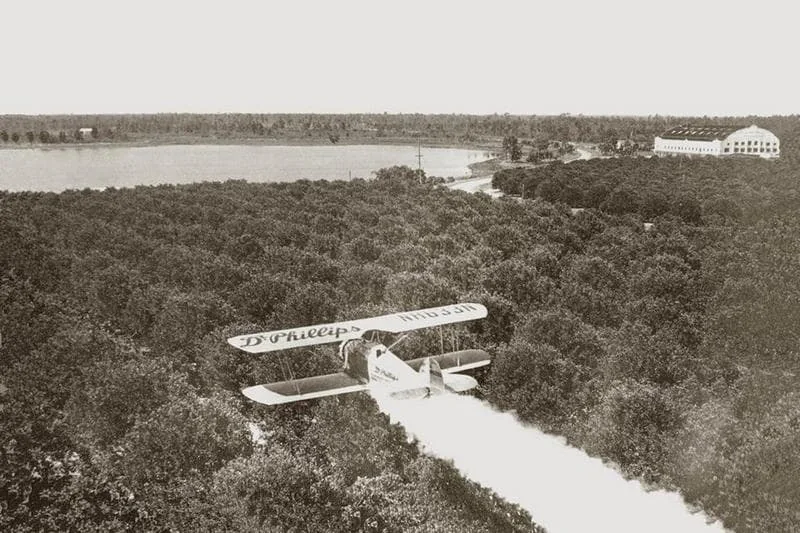
A black-and-white photograph of a biplane lettered Dr. Phillips flying low over a dense orange grove and trailing a plume of spray, with a lake behind it and a long packing house on the far shore.
Dr. Phillips, dusting his own groves from the air
The whole operation in one frame. A Dr. Phillips company plane spraying the groves above a lake near Orlando, with a company packing house on the far shore, in the grove country that is now Dr. Phillips and Bay Hill. Early aerial crop-dusting, which the Phillips operation was among the first in Florida to use. Via Florida Backroads Travel.

Stand on a dock in Lake Butler Harbor, or anywhere along the chain of lakes in the Dr. Phillips and Bay Hill part of town, and the water is clearly the point. The boats, the big lots, the view down a quiet cove. But for about half a century the view was something else entirely. It was rows. Orange trees in every direction, as far as a person could see, and almost all of it owned by a doctor from Tennessee who, as far as anyone can tell, never once practiced medicine.

His name was Philip Phillips, and everyone called him Doc. The medical degree was real, from Columbia up in New York. What he did with his life was oranges. More of them than anyone else alive.

So here is the question worth standing on a lakefront lawn and asking: how does one man come to own the biggest orange grove on earth, and what happened to all those trees?

A period promotional portrait of Dr. Philip Phillips, a man in a dark suit, printed above the words Dr. Phillips, Oranges, Grapefruit, Tangerines, and a line naming him the largest individual grower of oranges, grapefruit and tangerines in the world.
“Doc” Phillips
He had the title and never used it. A Dr. Phillips company portrait of Philip Phillips over the firm’s own standing claim: the largest individual grower of oranges, grapefruit, and tangerines in the world. Via Florida Backroads Travel.

The grove that froze, and the one that didn’t

Phillips came to Florida in 1894 chasing the thing half the country was chasing then: a grove of your own in a place where the fruit grew almost by itself. He bought one up near Satsuma. Within a year the Great Freeze of 1894 and 1895 came down the state and killed it to the ground, and like a lot of ruined men that winter, he left.

But he came back. By 1897 he was in Osceola County running cattle, and not long after he bought a grove on the south side of Big Sand Lake, a few miles down the road from where Lake Butler Harbor sits now. That one he kept. And then he started buying the grove next to it, and the one next to that.

A sepia photograph from around 1900 of neat rows of orange trees running down a gentle slope to the edge of a calm Central Florida lake.
Why the lakes, c. 1900
The water was the insurance. Orange groves running down to a lake near Orlando, around 1900. A big lake holds the day’s warmth and keeps the shore a few degrees above freezing on a cold night, so lakeside ground was the safest citrus ground in the state. Detroit Publishing Co.; Library of Congress.

The water was the whole bet. A deep lake gives the day’s heat back at night and keeps the shore a few degrees warmer than the land behind it, which on a freezing night is the difference between a crop and a loss. Phillips had learned that the hard way at Satsuma. The second time, he planted where the lakes could cover him.

A grove the size of a county

It is hard, now, to picture how much of this he ended up with. By 1920 he had pulled all of it together under one company and kept going until he was, by the industry’s own count, the largest individual grower of oranges, grapefruit, and tangerines in the world. His groves ran across nine Florida counties. Right here in southwest Orange County, his trees stretched from Conroy Road clear down to the far end of the Sand Lake chain, a solid block of citrus you could get lost in.

An 1890 map of Orange County, Florida, showing the chain of lakes west of Orlando, with township and section lines and a scatter of landowners' names across the grove country.
Orange County and its lakes, 1890
The ground, before one man gathered most of it up. An 1890 map of Orange County showing the chain of lakes west of Orlando, in the years just before Phillips began buying grove after grove along the water. J.O. Fries and E.W. Smith & Co.; Library of Congress.

A grove that big is not a farm. It is a small country. Somebody has to bud the young trees, fight the bugs, pick the fruit by hand, haul it, grade it, and pack it before it spoils. Thousands of people did that work for Phillips, and a lot of them lived right out in the trees, because there was nothing else out there yet.

So he built them a place to live. Housing for the workers, many of them brought over from the Bahamas, and a post office next to the train station so the mail had somewhere to go. He built a clinic too, for Black workers who were otherwise turned away from the doctors in town. It had its own name on the map before it was anybody’s suburb. The map just said Dr. Phillips.

A 1951 black-and-white photograph of fruit pickers with ladders and shoulder sacks working fast among heavily laden orange trees during a picking contest in an Orlando grove.
Picking time, Orlando, 1951
The work the fruit took. Pickers competing at the National Orange Picking Contest in an Orange County grove near Orlando, 1951. State Archives of Florida, Florida Memory.
A 1952 photograph of a Black citrus worker high on a ladder in an orange tree, reaching into the branches with a picking sack during a grove contest near Orlando.
Up the ladder, 1952
Every orange came down by hand. A worker picking during a grove contest near Orlando, 1952. State Archives of Florida, Florida Memory.

He was restless about the trees themselves, too. When bugs and fungus threatened the groves, Phillips was among the first growers in Florida to hire a plane and spray from the air, which is the strange image at the top of this page: a biplane with his name on the wing, dusting a sea of oranges above a lake, with one of his packing houses sitting on the far shore.

Teaching juice not to taste like a can

Growing the fruit was only half of it. The other half was the thing that actually made him rich, and it started with a complaint everyone in the business had just accepted: canned orange juice tasted like the can. Metallic, cooked, a little sad. People bought it anyway because there was no other way to drink an orange in July.

A vintage Dr. Phillips orange juice can label with the words Pure Orange Juice and an illustration of a cut orange beside a full glass of juice.
The payoff, in a can
The name went on the label. A Dr. Phillips brand orange juice label. The company’s flash-pasteurizing process is what let it put its own name on juice people actually wanted to drink. Dr. Phillips brand; via collected citrus labels.

Around 1929 the Phillips company set its people to fixing it, and they landed on a way to heat the juice hard and fast, a flash of heat just long enough to make it keep but too short to cook the orange out of it. Flash pasteurization. It sounds like a footnote. It was the whole game. Juice that tasted like juice could carry a brand, and the brand was his own name.

A black-and-white photograph of a cannery line with rows of metal cans being filled with orange juice concentrate inside a Florida citrus plant.
Twenty-four thousand a day
An orange, turned into a product. Cans moving down a Florida juice line. By 1931 the Dr. Phillips cannery was filling around twenty-four thousand cans a day. State Archives of Florida, Florida Memory.

By 1931 the cannery was filling around twenty-four thousand cans a day. Picture it: one building near Sand Lake, pouring out a boxcar of juice every few hours, every can something a family in Ohio could open in January and taste Florida. The packing house he built there was billed as the largest and most modern in the world, with a fertilizer plant and a private airstrip beside it.

A color linen postcard of a long white packing house with a red roof and a flag, captioned Dr. Phillips' Packing House at Dr. Phillips, Florida, with a line calling him the largest individual grower in the world.
The packing house they put on a postcard
Big enough to brag about. A period postcard of the Dr. Phillips packing house at Sand Lake, sold as the largest and most modern in the world. Linen-era postcard, Dr. Phillips, Florida.

It got local-famous enough that he ran a roadside juice stand out front where you could pull off the highway north of Orlando and drink all the fresh juice you wanted for a dime, then tour the packing house across the road. An orange empire with a gift shop.

A vintage printed advertisement for the Dr. P. Phillips Orange Juice Fountain reading Pure Fresh Orange Juice, all you can drink for 10 cents, visit our packing house just across from the fountain, north of Orlando on Route 441.
All you can drink, ten cents
The empire had a roadside stand. A Dr. P. Phillips advertisement for the juice fountain on the highway north of Orlando, inviting travelers to drink their fill and tour the packing house across the road. Dr. P. Phillips Company.

The day he sold the oranges and kept the land

Here is the turn that explains your street. In 1954, an old man by then, Phillips sold the whole citrus business, groves and brand and cannery, to Minute Maid and a partner. It was reported as the largest single deal in the history of the citrus industry. He walked away from oranges entirely.

But he did not sell everything. He kept the raw, undeveloped land, the room, and he poured the fortune into a foundation that still gives money away across Central Florida today. The oranges were a business. The ground was something he understood to be worth holding onto.

He sold the fruit and kept the dirt. Which tells you which one he thought was the asset.

And he was right. Over the next thirty years the freezes crept back and the groves north and west of Orlando mostly gave up, the way they had on him once before. The growers who kept going moved a hundred miles south, down where the cold rarely reaches. Up here the land did the other thing Florida land does. It grew houses.

A present-day aerial photograph of the Butler Chain of Lakes in southwest Orlando, with large waterfront homes and green lots wrapped around open blue water.
The same ground, now
Houses, where the rows were. The lakes and big lots of the Dr. Phillips and Bay Hill area today, on ground that was once solid Phillips citrus. Present-day aerial, southwest Orange County.

What’s left when the trees are gone

So go looking for the grove today and you will not find a tree. You will find his name on all of it instead. The Dr. Phillips neighborhood. Bay Hill, where the golf course sits on his old grove land. A hospital, a performing arts center, a foundation, all carrying the name of a doctor who grew oranges. Lake Butler Harbor itself is a piece of that same inheritance, a lakefront pocket cut out of what used to be rows.

A present-day photograph of a calm Butler Chain lakeshore in southwest Orlando with palms, oaks and open water under a bright sky.
Still the same water
The thing that was always the point. A Butler Chain lakeshore in the Dr. Phillips area, present day. The lakes that once kept the groves warm now keep the view.

What those groves were built on is still right there, because you cannot freeze room. The lakes are the same lakes that talked Phillips into planting here, and the lots run big because the groves ran big. So stand on that dock again. The water was never the whole reason. The reason was the room, and a man who could see what a lot of ground was worth standing empty. He just planted oranges on his. We plant something smaller on ours now.

A present-day note · Orange Tiny Homes

The room was always the asset. It just grows smaller things now.

Dr. Phillips understood one plain thing better than almost anyone: a piece of ground with room on it is worth holding, because sooner or later you put something useful out there. For fifty years the useful thing was oranges. The trees are gone. The instinct, and the room, never left.

These days the useful thing people build on their own room has a name, an ADU, an accessory dwelling unit, and it is what we build. A granny flat so a parent can live close with their own front door. A guest house. A rental cottage out back that helps carry the place. A tiny home on the far corner of the lot. The same instinct the grove families had when they put a second little house out among the trees, now with a kitchen, a bathroom, and a permit.

And you do not need grove acreage for it. The roomy lakefront lots around Lake Butler Harbor and Bay Hill, sure, but also ordinary yards in Conway, Pine Hills, Azalea Park, and Meadow Woods. Plenty of homes already have the space. What actually decides it comes down to your own address:

The real answer to “is there room out back for this?” is not a guess. It is a handful of facts about your lot, and that part we can check for you.

Put in your address and we will pull what your parcel allows and tell you whether a granny flat, guest house, rental, or tiny home actually fits, before you spend a dollar on drawings.

Start the ADU Fit Check→
Sources & Photo Credits

On the history

What is documented and what is representative: the Dr. Phillips portrait, packing-house postcard, juice label, fountain advertisement, and the company crop-dusting plane are genuine images of Philip Phillips and his company. The two picking photographs are genuine Orange County grove scenes near Orlando from 1951 and 1952, shown as representative of the hand labor the Phillips groves ran on, not identified as a specific Phillips grove. The juice-line photograph is a representative Florida cannery of the era. The 1890 county map and the circa-1900 grove-on-the-water are period Central Florida images used to set the scene. The two present-day photographs are of the Butler Chain lakes in the Dr. Phillips and Bay Hill area today. Lake Butler Harbor is a present-day lakefront neighborhood within that former grove country; this page does not claim its specific lots were a particular Phillips grove block. Full notes are in source-record.md beside this page.

Photographs

  1. Dr. Phillips company plane dusting the groves (hero): a biplane lettered Dr. Phillips spraying a grove above a lake, with a company packing house on the far shore. Via Florida Backroads Travel. File: dr-phillips-crop-duster-grove. florida-backroads-travel.com
  2. Philip Phillips, company portrait: a Dr. Phillips promotional portrait over the firm’s claim as the largest individual grower in the world. Via Florida Backroads Travel. File: dr-philip-phillips-portrait-ad. florida-backroads-travel.com
  3. Grove on the water near Orlando: orange groves running to a lake, circa 1900. Detroit Publishing Co.; Library of Congress. File: grove-on-the-water-orlando-c1900. loc.gov
  4. Orange County, 1890: map showing the chain of lakes west of Orlando. J.O. Fries and E.W. Smith & Co.; Library of Congress. File: orange-county-map-1890. loc.gov
  5. National Orange Picking Contest, Orlando: pickers in an Orange County grove, 1951. State Archives of Florida, Florida Memory. File: national-orange-picking-contest-orlando-1951. floridamemory.com
  6. Picking oranges near Orlando: a worker on a ladder during a grove contest, 1952. State Archives of Florida, Florida Memory. File: orange-picking-contest-orlando-1952. floridamemory.com
  7. Dr. Phillips orange juice label: a Dr. Phillips brand can label. Via collected Florida citrus labels. File: dr-phillips-orange-juice-label. cleancans.com
  8. Juice canning line: cans being filled on a Florida juice line, representative of the era. State Archives of Florida, Florida Memory. File: orange-juice-canning-line-florida. floridamemory.com
  9. Dr. Phillips packing house: a linen-era postcard of the Sand Lake packing house billed as the largest and most modern in the world. File: dr-phillips-packing-house-postcard. cardcow.com
  10. Dr. P. Phillips juice fountain advertisement: a period ad for the roadside juice fountain north of Orlando and the packing-house tour across the road. Dr. P. Phillips Company. File: dr-phillips-juice-fountain-ad.
  11. Butler Chain today, aerial: present-day lakes and lots of the Dr. Phillips and Bay Hill area. File: butler-chain-aerial-windermere. windermerefl.com
  12. Butler Chain lakeshore today: a present-day lakeshore in the Dr. Phillips area. Via Wikimedia Commons. File: butler-chain-shoreline-today. commons.wikimedia.org

Original downloads and a full research record are kept alongside this page in assets/images/originals/ and source-record.md. No historical image was altered in any way that changes its content. The Polaroid frames and handwritten notes are CSS added around the images, never onto them.