There’s a guardhouse out past Windermere, on a point of land that pushes into the Butler Chain of Lakes, and you don’t drive past it unless somebody inside is expecting you. Behind it: a Jack Nicklaus golf course, some of the pricier houses in Orange County, docks on clear water. The name on the gate is Keene’s Pointe. And Keene wasn’t a golfer, or a developer, or anybody’s idea of old money.
He was a man who started out picking other people’s oranges off a ladder. So how does a grove hand’s name end up on one of the most guarded gates in the county — and on a public boat ramp right next to it?
A boy, a ladder, and the worst winter anyone could remember
Rodolphus Dolph Keene was born in 1885, and the way the story gets told, he was in the groves as a boy near Kissimmee — working his father’s trees when the cold came down the winter he was ten. That winter has a name. On the night after Christmas in 1894 a freeze killed the fruit across Central Florida, and when growers thought they’d taken their hit, a second freeze in February of 1895 killed the trees themselves. People still call it the Great Freeze, and it broke the back of the citrus business up here.

Plenty of families left Florida for good after that. Keene didn’t. He stayed in oranges, and he learned the business the long way — from the bottom. By 1907 he was working groves for Dr. P. Phillips, the Orlando grower who would become the biggest citrus name in the region and one of the men who figured out how to can and ship the state’s orange juice. If you wanted to learn how Florida citrus actually worked — the picking, the grading, the shipping, the money — there were worse places to stand than in Dr. Phillips’ groves.
The year he stopped working other men’s fruit
The jump from laborer to owner is the hinge of the thing. In 1922 Keene and a partner, Barney Dillard Jr., bought a packinghouse of their own over in Eustis. That’s the moment the fruit stops belonging to somebody else. A grove is a slow bet — you plant trees and wait most of a decade before they really pay — but a packinghouse is the choke point every grower in the district has to come through to get paid. Own the packinghouse and you’re no longer the man on the ladder. You’re the man the ladders work for.

In 1933 he moved the whole operation to Winter Garden, west of Orlando, and he never left. He put up a packinghouse there and then kept building onto it — which is the part that tells you who he was. A man who’d come up picking fruit didn’t stop at one shed. He helped start the Winter Garden Citrus Products Cooperative and ran it as its chief executive into the 1960s, and the plant kept getting bigger: from plain single-strength juice to frozen concentrate, until it was one of the largest concentrate plants in the state.
That last part is quietly the revenge on 1895. The freeze that ruined his childhood groves destroyed fruit because fresh fruit can’t wait. Juice you can freeze into concentrate doesn’t rot on the dock — it keeps, and it ships to a cold city in January. The boy who watched a freeze take everything spent his adulthood helping build the thing a freeze couldn’t touch.

The point on the lakes
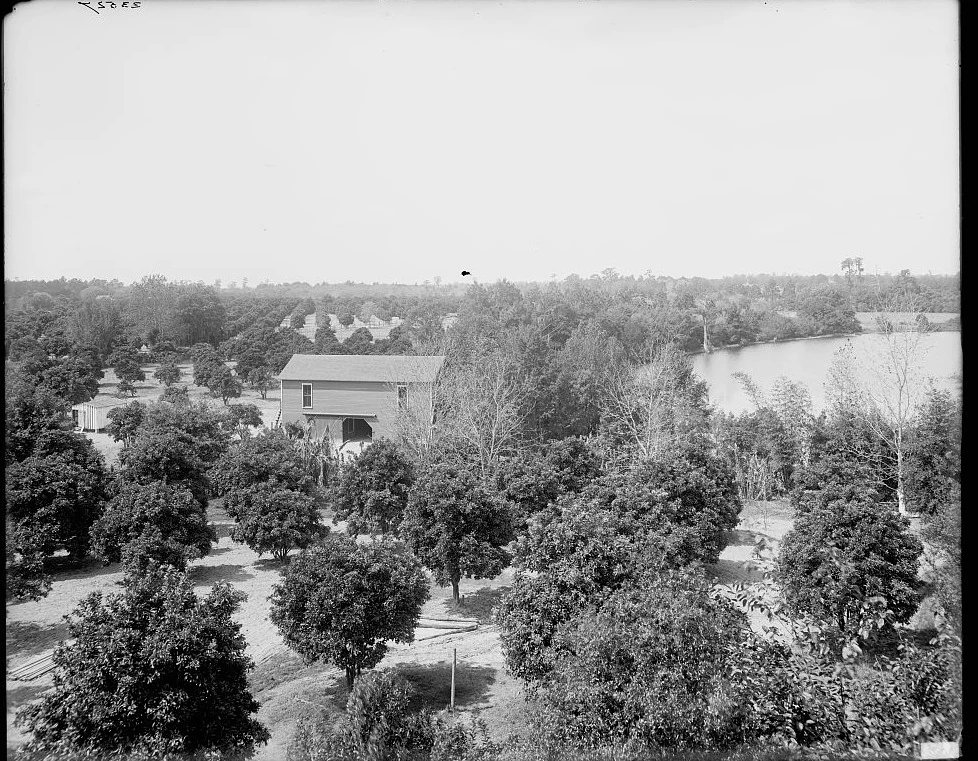
Somewhere in those years Keene did what a Florida citrus man with money did: he got himself room. Grove land, out on a point that reached into Lake Tibet-Butler, down at the lower end of the Butler Chain near Windermere. It was good ground for the same reason the whole chain was good ground — big water holds its heat overnight and keeps the grove around it a few saving degrees warmer when the cold comes. After 1895, every grower in Central Florida knew exactly what that was worth.

And the work it took hadn’t changed much since Keene was the boy on the ladder. Somebody still climbed up into every tree. A grove was only ever worth what the crews could get off the branches and into the field crates before it spoiled — which is the other reason a man who owned the packinghouse and the concentrate plant wanted to own the grove too. Control the whole line, from the tree to the frozen can, and no single bad winter could end you.

None of this was unusual, exactly — it was just how this corner of Florida got built, and had been since before the groves. Families came down, claimed their acres out in the pine and palmetto, and added on a piece at a time: a house, then a barn, then a packing shed, then more grove when there was money for more trees. The map of Orange County was a record of people getting room and putting things on it. Keene did the same thing, at the scale a packinghouse and a concentrate plant will buy you.

Why the groves gave way
The citrus didn’t last out there forever. More hard freezes rolled through Central Florida in the decades after the war, and each one chipped at the groves. By the time Orlando started sprawling west toward the lakes, grove land this close to a growing city was worth more with houses on it than with trees — and lakefront grove land most of all. The old point was ground waiting for its next use.
It came in the late 1990s. A developer, Castle & Cooke, took the former grove and timber land on the point and turned it into a gated community wrapped around a golf course — the Golden Bear Club, a Jack Nicklaus signature course that opened in 1999. The gate went up; the custom houses went in; the docks reached out into the Butler Chain. And the name they kept for the whole thing was the name already on the land. Keene’s Pointe.
What’s still out there with his name on it
Here’s the part that would’ve pleased a man who started on a ladder. The gate isn’t the only thing carrying his name out there. Right next to it, on the water, is R.D. Keene Park — fifty-some acres the county runs, with ball fields and a boat ramp that’s one of only a couple of public ways onto the whole Butler Chain of Lakes. A grove hand’s name ended up on the gate the public can’t use, and on the ramp anybody can back a trailer down.

The trees are mostly gone. The lakes are not. The Butler Chain is still clear water, still the reason anyone wanted this point of land in the first place — the same big water that once kept Keene’s oranges from freezing now keeps the view from a back lawn and floats the boats off his ramp.

A boy stood in a grove near Kissimmee the winter everything froze, and instead of leaving he spent the next sixty years getting more room than the last man had — a packinghouse, then a bigger one, then a plant that could freeze the juice a freeze couldn’t ruin, and finally a point of land on the water. He didn’t keep any of it in the end. But the name stuck to the ground, the way it does when somebody holds a piece of Florida long enough.


