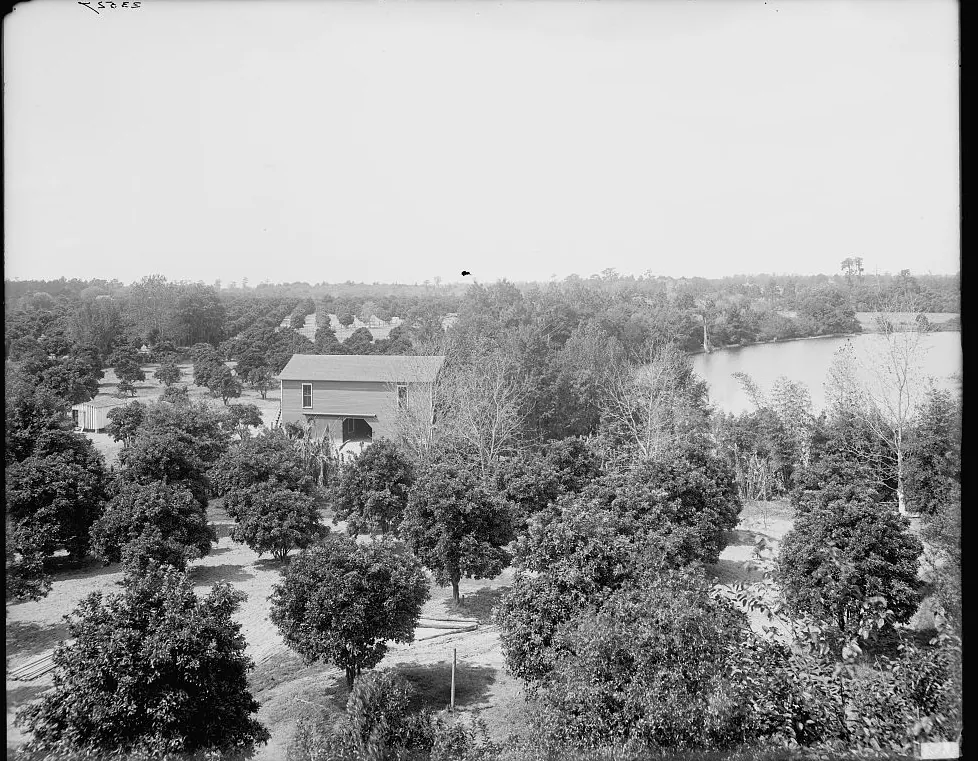
Out past Windermere, tucked into the Butler Chain of Lakes, there’s a gate you don’t drive through unless you’re invited. Behind it is Isleworth — some of the most expensive houses in Florida, a golf course that’s eaten its share of famous names, the kind of place that shows up in tabloids more than history books. And the whole thing is named after an orange.
Not the golf. Not the lakes exactly. The name goes back to two brothers who grew citrus here, and who called this ground the “Isle of Worth” for one plain reason: the fruit didn’t die out here when it died nearly everywhere else. So how does a patch of frost-shy orange grove end up being the most valuable word in a billionaire’s address?
The two winters that ended an industry
To understand the “worth,” you have to understand what happened to everybody who didn’t have it. On the night after Christmas in 1894, the cold came down into Central Florida and killed the fruit on the trees. Growers figured they’d taken their hit and started over. Then in February it came back and killed the trees themselves. People later called it the Great Freeze, and it broke the back of the citrus business up here.

The number that still gets quoted is the temperature drop — better than sixty degrees in a single day, warm shirtsleeve afternoon to hard killing freeze by the next morning. A grove is a slow bet. You plant the trees and wait the better part of a decade before they really pay you. Almost nobody had the cash to sit out those years twice, so the small growers were finished. Thousands of acres got walked away from. A lot of families left Florida for good, and a lot of the ones who stayed in citrus picked up and moved the whole operation south, chasing warmer ground down toward Polk County.
The brothers who bought instead of ran
Sydney Chase came down from Philadelphia to Sanford in 1878 — a young man learning the orange business from the ground up, working General Henry Sanford’s experimental groves at a place called Belair. His older brother Joshua joined him in 1884, and the two of them hung out a shingle: Chase & Company. They started the careful way, selling other growers the dull necessary things — fertilizer, fire insurance — and only later put their own money into their own trees.

So when the freeze gutted everyone else, the Chases were exactly the sort of operation that could do the thing almost nobody else could: keep going, and go bigger. While wiped-out growers were selling their land for whatever they could get, the brothers were buying it. That’s the move the whole story turns on. A freeze that reads as a catastrophe to a man with one grove reads as a clearance sale to two men with capital and nerve.

The Isle of Worth
What they were buying, out by the lakes west of Orlando, was room — and a particular kind of room. By 1886 the brothers had put together a grove near Windermere that ran to around thirteen hundred acres, laid along the Butler Chain of Lakes. That’s the piece they called the Isle of Worth.
The name wasn’t poetry. Big water is a blanket. A grove ringed by deep lakes rides out a cold snap that flattens a grove sitting alone in open flatwoods, because all that water gives its heat back slowly through the night and keeps the air around the trees a few saving degrees warmer. Growers knew it, and they paid for it. Ground that kept its fruit through a freeze was worth more than ground that didn’t — a lot more, after 1895 made the difference life or death. An island of trees that held its oranges really was an isle of worth.

Citrus was the point of nearly all of it. You set the trees, waited out the years, and then a good grove paid you back every winter — northern cities buried in snow and down here the fruit coming off the branch. The brothers kept at it for generations. Sydney built a cypress bungalow on Lake Louise in 1913; years later his son Frank came out to run things, and Frank and his wife Helen lived in that lake house until the 1980s. For most of a century, this was family citrus ground on the water.


Room was the whole game
Here’s the part that outlasted the citrus. The Chase move — get a piece of ground with room on it, and put the thing you want out there yourself — wasn’t some rich-man’s trick. That was just how this corner of Florida got built, up and down the scale.
Before the groves and alongside them, this was open country. Cattle ran loose across unfenced miles of pine and palmetto; a man’s wealth was partly how much room his herd could wander. Families came down, claimed their acres, and built a little at a time — a house, then a barn, then a packing shed, then a second small place out back when more family turned up. Nobody finished a homestead in a season. You added on as life asked you to, because the room was sitting there to add onto.

And the names out here tell on themselves. Windermere, just up the road, was platted in 1887 by an Englishman who named it after a lake back home in England’s Lake District. The whole area is people who found a piece of Florida with water and room and decided to make it theirs. The Chases just did it at grove scale, and gave their piece a name that happened to stick.

From groves to gates
The citrus didn’t last forever, even out here. More hard freezes came through in the decades after the war — the late 1940s, the late 1950s — and each one chipped at the groves. By the 1960s and ’70s the economics had shifted, and lakefront grove land near a growing Orlando was starting to be worth more with houses on it than with trees. The old Isle of Worth was ground waiting for its next use.
It came from the air. In 1984 Arnold Palmer flew over the Chase lands by the Butler Chain, saw the lakes and the room, and bought it to build a golf course with a community wrapped around it. The descendants sold; the grove became the gate. The name they kept — Isleworth — is the brothers’ old word for the same simple thing the golfers are paying for now. Good ground, by the water, with room.
What’s still out there
The trees are mostly gone. The lakes are not. The Butler Chain is still here, still clear, still the reason anyone wanted this spot in the first place — the same big water that once kept a grove from freezing now keeps the view from a back lawn.

Two brothers came to the flat middle of Florida, found a piece of ground where the oranges didn’t die, and answered the worst winter anyone could remember by getting more of it. A hundred and some years later the fruit is gone and the name is on a guardhouse — but the thing it was pointing at the whole time, the room by the water, never went anywhere.


