Estancia at Windermere, Lake Down · Orlando, Florida  ·  A Local History

The Grove That Came With Two Houses


The gate borrows a Spanish word for a working country estate, and it turns out to fit the ground under it. For the whole citrus century out here, a grove this size usually held two houses: the owner’s, and a second one for the family who actually lived on the land and ran it.

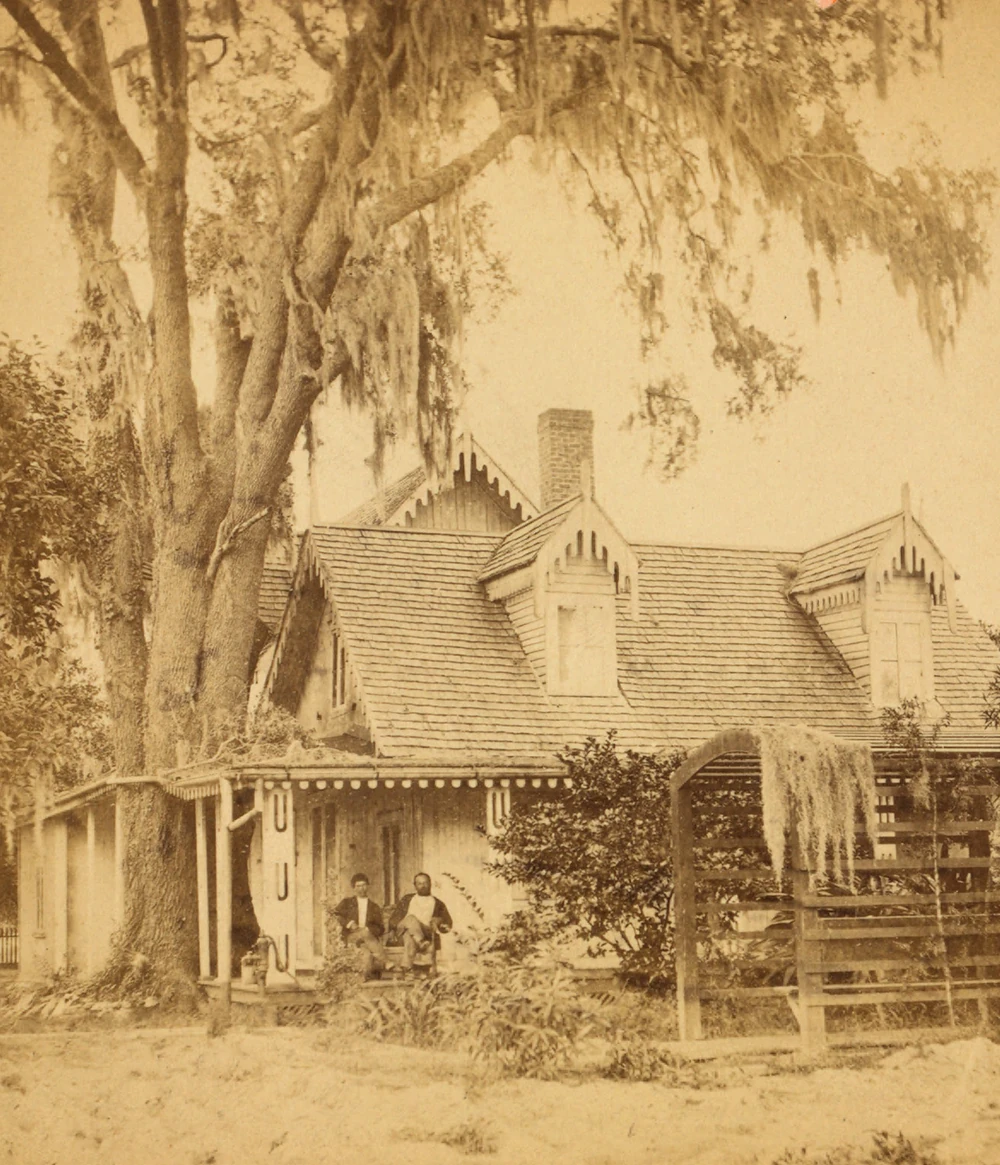
A gabled wood cottage with a long front porch set under huge live oaks hung with Spanish moss, two people seated on the porch, a rail fence and a bare sandy yard in front.
A winter owner’s place in the grove, Mandarin
The house in the orange grove. The Florida cottage of author Harriet Beecher Stowe at Mandarin, on the St. Johns River, with its orange grove around it. Stereoview, The Southern Series, C. Seaver Jr., about the 1870s to 1880s, via the New York Public Library and Wikimedia Commons.

The name on the gate is Spanish. Estancia. In the old Spanish world it meant a working country estate, the kind of place that ran on land and cattle and distance, a house at the center and a whole operation spread out around it. Stamp a word like that on a short street off Lake Down and it sounds like a developer reaching for something grand.

Except out here it lands close to the plain truth. For most of the time anyone has worked this ground west of Orlando, a piece of it this size did not hold one house. It held two, and sometimes more.

So here is the thing worth stopping on. Why would a grove come with a second house, and who lived in it?

Grove country, room measured big

Rows of young orange trees heavy with fruit standing over open, bare sandy ground, their trunks whitewashed, a small figure walking far back among them.
A Florida orange grove, about 1900
The country this was. A fruiting Florida orange grove over open sandy ground, whitewashed trunks, a worker far back among the rows. Colorized view published by the Detroit Publishing Co., around 1900. Via Wikimedia Commons. A period scene of the region, not of Lake Down itself.

Picture this corner of Orange County before the walls and the retention ponds. A high sandy ridge, the Butler Chain of lakes strung across it, and orange trees running down to the water of Lake Down in long whitewashed rows.

A family that came here to grow citrus got one thing in real supply and very little else. Room. Acres of it, no store, no power line, no help within earshot. You bought ground by the grove out here, not by the lot, and the grove set the terms.

The owner was often somewhere else

Several women in long dresses and an older bearded man seated together on the shaded porch of a wood cottage, a massive oak trunk rising at the right edge of the porch.
The Stowe family on the porch, Mandarin
A northern family, wintering south. “Residence of Prof. and Mrs. H. B. Stowe, with Family Group,” at Mandarin, Florida. Stereoview, The Southern Series, C. Seaver Jr., about the 1870s. Via the New York Public Library and Wikimedia Commons.

Here is the first surprise. The person whose name was on the grove very often did not live on it.

A good many of these groves belonged to people who spent their winters in Florida and their summers up North. The best known of them kept her place a little north of here, on the St. Johns at Mandarin, where the author Harriet Beecher Stowe had a cottage under the live oaks with an orange grove around it, and wrote home about the fruit. She is only the famous version of a common arrangement. Plenty of Orlando men owned a grove out toward the lakes and ran the rest of their lives in town.

A grove does not care where its owner sleeps. It needs somebody on the ground every day of the year.

So, the second house

A modest one-story frame cottage with a deep columned porch, a brick chimney and a green metal roof, standing in a grassy clearing among trees.
The kind of cottage that stood out in the trees
The smaller roof. A preserved Florida “Cracker” cottage, the plain frame type once used as a grove keeper’s house and as a northern owner’s retreat (this one is the Gamble Place cottage at Port Orange). Present-day photograph, via Wikimedia Commons.

Which is the reason for the second house. If the owner was up in Hartford or Boston, or just downtown Orlando, a different family lived on the grove and ran it. A keeper.

They had their own small house out among the trees, usually a plain frame cottage set off from the big one, and the work of the place was theirs. The pruning, the plowing, the watching of the weather, the picking at the right week, the loading of the fruit. Two households on one piece of ground, and only one of them held the deed.

The night somebody had to be there

A squat cast-iron grove heater standing on gravel, its tall chimney throwing a bright yellow flame, with a wood fence behind it.
A grove heater, lit
The two-in-the-morning job. A surviving Florida grove smudge pot, the oil-burning heater lit the way it once was on freeze nights under the orange trees. Present-day photograph, via Wikimedia Commons.

You could not run a Florida grove by mail, and one kind of night made the reason plain.

When the cold slid down the peninsula, which it did every few winters, a grove could be lost between midnight and dawn. The only defense was heat. Smudge pots and grove heaters, squat iron things that burned oil and threw a little warmth and a great deal of oily black smoke under the trees, a film of it left on the leaves and the laundry and the back of your throat by morning.

Somebody had to be standing in that grove at two in the morning, lighting them in the dark, row by row, while the thermometer kept dropping. That somebody lived in the second house. An owner up North could read about the freeze in a letter a week later. The keeper felt it in his hands.

And the fruit had to go somewhere

The interior of a large steel-framed shed where rows of workers stand at long grading tables and sloping conveyor runs carry crates and loose oranges past bins piled with fruit.
Inside a Florida packing house
Where the crop turned into a shipment. “A Modern Orange Packing House, Florida,” workers grading and crating fruit for the trip North. Linen postcard, about 1935. Via Wikimedia Commons.

When the picking was good, the whole district turned into one long job. The fruit came out of the groves and into a packing house, a barn of a building where it was washed, sized, wrapped, and crated for the train North.

That was its own crowd of hands, its own set of small wages, its own reason for people to live close to the work. The grove made the town, and the town was mostly built to move oranges.

What emptied the second house

Then, over about a lifetime, the second house lost its job.

The freezes came back hard, the worst of them in the 1890s and again in the 1980s, and after enough of them the groves out here did not get replanted. Roads reached the lakes, then subdivisions did. The land stopped selling by the grove and started selling by the lot, and the rules that came with the lots said one house to a parcel. The keeper’s cottage, the thing that had always stood out in the trees, had no line left to sit on.

What stayed

A grassy lakeside park with tall palms and spreading oaks, a bench and an open bay of water beyond under a blue sky.
Lake Down today
The room outlasted the oranges. The shore of Lake Down at Windermere, the same water the grove rows once ran down to. Present-day photograph, via Wikimedia Commons.

But the room stayed. Windermere and the pockets around it, Gotha to the north, the lanes toward Winter Garden and Ocoee, held onto the one thing the groves were laid out on. Big ground. The town kept its oversized lots and even some of its sand streets on purpose, and the newer walled places like Estancia followed the same habit, setting a short row of houses onto parcels a grove would still recognize.

So the word on the gate turns out to fit the ground better than it was probably meant to. An estancia was never one building. It was a piece of land with enough room to hold a whole working household, and then a little more. That is what this ground was when it grew oranges, and underneath the walls it is what it still is. The second house out there was never a luxury and never a trend. It was just what people built when they had the room and a reason, which, out here, they almost always did.

A present-day note · Orange Tiny Homes

The room out back is still asking the same question.

The old groves answered it with a second building. You have the ground, so what do you put on it? A keeper’s cottage. A house for the family that ran the place. A smaller roof for whoever needed to be close to the work. The need moved around. The instinct stayed put.

These days that second building has a name, an ADU, an accessory dwelling unit, and it is what we build. A granny flat so a parent can live close with their own door and their own kitchen. A guest house. A small rental cottage out back that helps carry the place. A tiny home in the far corner of the lot. The same old move, now with a bathroom, a kitchen, and a permit.

Estancia’s lots are built for it, the deep kind the groves left behind. But you do not need acreage. Plenty of ordinary yards in Ocoee, Winter Garden, Conway, and Pine Hills already have the room. What actually decides it comes down to your own address:

The real answer to “is there room out back for this?” isn’t a guess. It’s a handful of facts about your lot, and that part we can check for you.

Put in your address and we will pull what your parcel allows and tell you whether a granny flat, guest house, rental, or tiny home actually fits, before you spend a dollar on drawings.

Start the ADU Fit Check→
Sources & Photo Credits

On the history

What is documented and what is representative: this page tells a regional pattern, the grove that carried two households, through real examples. The Harriet Beecher Stowe cottage images are period photographs of her actual Florida place at Mandarin (not Lake Down). The “Cracker” keeper’s-cottage photograph is a present-day image of a preserved cottage (Gamble Place, Port Orange), standing in for the plain frame cottage type once common on Central Florida groves, and is labeled as present-day. The orange-grove, packing-house, grove-heater, and Lake Down images are each labeled with their own date and place. No image claims to show a building that stood on Estancia’s parcels. Full notes are in source-record.md beside this page.

Photographs

  1. Stowe cottage at Mandarin (hero): the Florida residence of Harriet Beecher Stowe at Mandarin, on the St. Johns River, under live oaks, two figures on the porch; stereoview, The Southern Series, C. Seaver Jr., about the 1870s to 1880s. New York Public Library, via Wikimedia Commons. File: stowe-cottage-mandarin. commons.wikimedia.org
  2. A Florida orange grove, about 1900: a fruiting grove over open sandy ground, colorized view, Detroit Publishing Co.; period scene of the region. Via Wikimedia Commons. File: a-florida-orange-grove-c1900.
  3. Stowe family on the porch: “Residence of Prof. and Mrs. H. B. Stowe, with Family Group,” Mandarin, Florida; stereoview, The Southern Series, C. Seaver Jr., about the 1870s. New York Public Library, via Wikimedia Commons. File: stowe-family-on-the-porch.
  4. Preserved “Cracker” cottage: the Gamble Place cottage (“Egwanulti”) at Port Orange, Florida, a plain frame cottage of the grove-keeper / retreat type; present-day photograph, via Wikimedia Commons. File: cracker-cottage. commons.wikimedia.org
  5. Grove smudge pot, lit: a surviving Florida orange-grove heater burning, of the kind used on freeze nights; present-day photograph, via Wikimedia Commons. File: grove-smudge-pot.
  6. Orange packing house, about 1935: “A Modern Orange Packing House, Florida,” workers grading and crating fruit; linen postcard. Via Wikimedia Commons. File: orange-packing-house-c1935.
  7. Lake Down today: the lakeside at Windermere, present-day. Via Wikimedia Commons. File: lake-down-today.

Original downloads and a full research record are kept alongside this page in assets/images/originals/ and source-record.md. No historical image was altered in a way that changes its content; stereoviews were cropped to a single frame and postcards to the image area. The Polaroid frames and handwritten notes are CSS added around the images, never onto them. Present-day photographs are labeled as present-day; the period images are labeled with their own dates.