Chuluota, Florida  ·  A Local History

The Hotel Flagler Built
in the Wilds


The man who gave Florida its glittering east coast put a small brick lodge out on a lake in the Chuluota pinewoods — far from everything, on purpose — and bet the quiet little place would grow into a rival for Orlando. The town never did. But the building, and the room it was built on, are still out there.

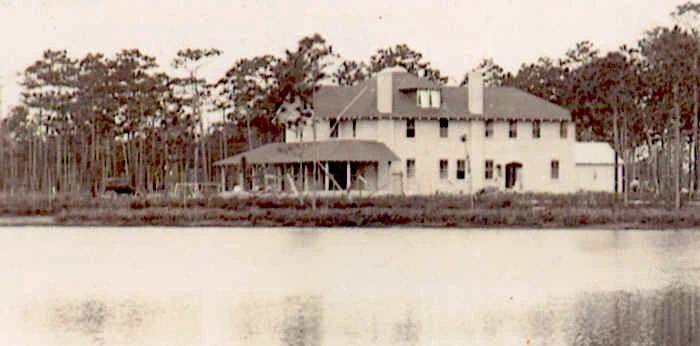
A two-and-a-half-story building with a wide covered porch, seen from across a still lake, framed by tall pine trees against a pale sky.
The Chuluota Inn, across Lake Catherine
The lodge in the pines. The Chuluota Inn on Lake Catherine, built by Henry Flagler’s Chuluota Land Company and opened in 1914. From the historical collection of the Lake Catherine property (the former inn), Chuluota, Florida.

Sometime in the 1960s, a land man poking around a little brick hotel out past Oviedo turned up an old guest register. In it were the names of a count and a princess. They had come down the railroad from St. Augustine, signed the book, and gone out into the Florida scrub. “I guess,” he said later, “they came here to see the wilds.”

The hotel was the Chuluota Inn, and it had no business keeping the company it kept. It sat on a small lake, deep in the pinewoods, at the dead end of a railroad spur, a long sandy way from anything you’d call a city. As local history tells it, the guest book over the years ran to names like DuPont, Dodge, Cabot, and Rockefeller.

So here’s the question that land man was circling. Why would a Rockefeller get on a train and ride all the way out to the middle of the Seminole County pines?

The man with more money than almost anyone

An engraved portrait of a clean-shaven older man in a high collar and dark coat, with his signature beneath.
Henry M. Flagler
The man who built the coast. Henry Morrison Flagler (1830–1913), John D. Rockefeller’s partner in Standard Oil, who spent his second fortune building the east coast of Florida. Portrait engraving, public domain.

His name was Henry Flagler, and he had helped John D. Rockefeller build Standard Oil into the richest company in America. Then, in his fifties, he came to Florida and spent the rest of his life and most of his money building the state’s whole east coast — a railroad running all the way down the shore, and a string of palace hotels to put people up at the end of the line.

The grandest of them stood at St. Augustine: twin towers, red-tile roofs, courtyards of palms, something like five hundred rooms. Wealthy families from the North rode down in private railway cars and stayed the winter. The entire machine existed to carry rich people south in comfort and set them down inside a palace.

A large Spanish-Renaissance resort hotel with two tall towers, red-tile roofs and formal gardens with palm trees and horse carriages out front, in tinted color.
What his guests were used to
The other end of the railroad. Flagler’s Hotel Ponce de Leon at St. Augustine, the kind of palace his guests came south for. Detroit Photographic Co. photochrom, circa 1902; Library of Congress (public domain).

But here’s the thing about people who can have a palace whenever they want one. Every so often what they actually want is the opposite — to get out of the velvet rooms, pick up a shotgun, and disappear into country that still looks like nothing at all. And Flagler, who paid very close attention to what his guests wanted, had an answer for that too.

He sent them inland, to the room

He sent them into the pines. Flagler’s Chuluota Land Company bought up the lake-and-pinewoods country southeast of Sanford, and the plan was a good deal bigger than a hunting trip. He meant to grow Chuluota into a real town — one that could rival Orlando as the trading center for that whole stretch of Central Florida.

A 1920 black-and-white county map showing Sanford as a large labeled town at top, with rail lines branching out to small dots including Chuluota at lower right, near Oviedo and Lake Pickett.
Chuluota — the far end of the line, 1920
A small dot, and a big idea. Chuluota sits at the lower right, out past Oviedo at the end of a rail line, while Sanford fills the top of the map. Detail from a 1920 map of Seminole County; U.S. Railroad Administration, 1920, via the Florida Center for Instructional Technology, University of South Florida.

The ground was already settled, in the loose way the back country got settled. After the Civil War, families had come down from North Carolina by boat and ox-cart and spread out around the lakes — cattle people, grove people, a scatter of homesteads near Lake Mills. They’re the ones who gave the place its soft Creek name, which depending on who you ask means the Isle of Pines, or the Land of Lakes and Pines. Either way it meant the same thing on the ground: pine, sand, water, and as much room as a person cared to clear.

A sandy road running straight into tall, widely spaced Florida pine trees at golden hour, with a single horse and buggy far down the road, in tinted color.
The “wilds” they came to see
A sandy road into the pines. Open longleaf-pine country of the kind that covered the Chuluota lakes — the “wilds” a count and a Rockefeller rode the train out to find. Detroit Photographic Co. photochrom, 1904 (public domain). A representative scene of the region, not Chuluota itself.

That was the product. Not another palace — room. Flagler was selling a few weeks of nothing-around-you to people who could buy anything else.

The lodge goes up

So his company built them somewhere to sleep that matched the idea — plain on the outside, solid as a bank underneath. A two-and-a-half-story brick hotel on the shore of Lake Catherine, twenty-five rooms wrapped around a central staircase, with a wide porch to sit on and watch the water.

A large brick building under construction on bare sandy ground, its walls up and a covered porch framed out toward a lake, with piles of brick and rubble in front and pines behind.
Going up on Lake Catherine — 1912
Built like it meant to stay. The Chuluota Inn under construction in 1912 — raw brick walls rising on the sand, the lakeside porch framed out. Historical collection of the Lake Catherine property (the former inn), Chuluota, Florida.

The walls were the giveaway. They laid the brick three courses thick — better than a foot of solid masonry, thick as a man’s forearm — partly for the hurricanes that came through those years, and partly because brick that heavy keeps a building cool through a Florida afternoon and gives the warmth back at night, the way an old adobe house does. They put claw-foot tubs in the rooms and ran steam heat to them. And then the man whose idea the whole thing was never got to see it open: Flagler died in 1913. The inn welcomed its first guests on Thanksgiving Day the next year, finished to the plan of a man already a year gone.

A passenger train of several wooden cars stopped on a rail line in the pines, with men standing beside it and a small open-sided depot and an early automobile at right.
The spur that reached it — about 1918
How everything arrived. A passenger train at the Chuluota depot, around 1918. A spur of Flagler’s Florida East Coast Railway ran out to the town, carrying the guests in and the hotel’s supplies with them. Historical collection of the Lake Catherine property, Chuluota, Florida.

A spur of Flagler’s railroad ran right out to the little town, and down it came everything the inn needed — the linens, the food, and the guests themselves, stepping off the cars into the pine air.

Two women in long white dresses sitting at a small table playing cards on a wide hotel porch, with a row of wooden rocking chairs, ferns, a brick column, and pinewoods beyond.
An afternoon on the porch
What there was to do. Guests at cards on the Chuluota Inn’s long front porch, about the 1910s — rocking chairs, ferns, and the pines past the rail. Historical collection of the Lake Catherine property, Chuluota, Florida.

What they got for it was exactly what Flagler had guessed the rich would pay for when they were tired of being rich at everybody. Good air. Bass and quail. Eggs and milk and vegetables off the local farms. A room went for four dollars a day with every meal thrown in. A Sanford newspaper ad from 1928 pitched it plainly: a quiet, restful resort in the lake country, forty minutes over paved highway from Sanford and Orlando, where “the lover of natural sport will find good hunting and fishing… and the feeling of the outdoors is a recreation in itself.”

Flagler built a palace on the coast for people who wanted to be seen — and a plain brick lodge in the pines for the very same people, for the weeks they wanted to disappear.

The town that didn’t happen

The part Flagler bet on — the town — never came. The citrus that the first settlers had staked everything on was already gone, killed off in the Great Freeze of the mid-1890s. Then the 1920s land boom that was supposed to make Chuluota went bust. The seven sawmills that had hummed around Lake Mills shut down. The trains stopped coming in the 1930s, and in the 1940s the tracks themselves were pulled up out of the sand.

Chuluota did not become a rival to Orlando. It did the opposite. It went quiet again, back to being pine and lake and scattered ground — the exact thing it had been before anyone drew a town on it.

What stayed standing

But the building wouldn’t quit. By the 1950s, retired military families were putting up houses around the old inn, and somebody reopened it — this time as the Lake Catherine Inn, the one big place in a small town. The Sportsmen’s Club met there. So did American Legion Post 225. There were Christmas parties and New Year’s dinner-dances, and a hand-cranked, mimeographed newsletter called, of course, the Chuluota Challenger, which told everybody which clubs were meeting at the inn that week.

The same two-and-a-half-story building today, its brick now under pale stucco with a green awning and a sign, shaded by large trees on a quiet residential lot.
Still here — apartments now
The lodge, still full of people. The former Chuluota Inn today, stuccoed over its original brick and divided into apartments — the Lake Catherine building, Chuluota. A present-day photograph.

Then a nursing home for a while. And since the 1980s, apartments — the big central staircase now the spine of a building full of front doors. The brick Flagler’s company laid a forearm thick is still standing on Lake Catherine, still cool on a hot day exactly the way the builders meant it to be, still keeping people out of the weather more than a century on.

The thing it always had

The count and the princess came to see the wilds. The wilds mostly won. Chuluota never did fill in the way Orlando did, and if you drive its roads now you’re right back in that old back-country habit of spreading out — big lots, pasture, a few groves that outlasted the freezes, houses set a long way apart with a lot of ground in between.

Flagler bet that the room would turn into a city. He had it backwards. The room was the thing worth having all along — and the hotel he built to rent a few weeks of it is the place people call home now.

A present-day note · Orange Tiny Homes

The best thing out back is usually the room itself.

Chuluota’s whole story turns on one rural-Florida instinct: when you’ve got ground, you put something useful on it. Flagler put a lodge out on a lake. The old homestead families put groves and pasture and a second cabin for whoever needed one. The land out back was never just scenery — it was where the next thing went.

That instinct still pays. These days the thing people build out back has a name — an ADU, an accessory dwelling unit — and it’s what we build. A granny flat so a parent can live close and still have their own front door. A guest house. A rental out back that helps carry the place. A tiny home on the far corner of the lot. Same idea those roomy Chuluota lots were settled on, just with a kitchen, a bathroom, and a permit.

And you don’t need a homesteader’s acreage to do it. Across greater Orlando — the big lots out east by Chuluota, Geneva, and Oviedo, sure, but also ordinary yards in Apopka, Ocoee, Winter Garden, Conway, and Pine Hills — plenty of homes already have the space. What actually decides it comes down to your own address:

The real answer to “is there room out back for this?” isn’t a guess — it’s a handful of facts about your lot. That part we can check for you.

Put in your address and we’ll pull what your parcel allows and tell you whether a granny flat, guest house, rental, or tiny home actually fits — before you spend a dollar on drawings.

Start the ADU Fit Check→
Sources & Photo Credits

On the history

Early Chuluota survives mostly in a local-history page kept by the owners of the former inn, in newspaper clippings held by the Seminole County Historical Society, and in encyclopedia entries, rather than a deep photographic archive of the town. The four early photographs here (the inn across the lake, the 1912 construction, the porch, and the depot train) are the genuine town, from the former inn’s own historical collection. The guest-list names (DuPont, Dodge, Cabot, Rockefeller) and the count-and-princess register come from newspaper clippings cited on that page and are presented here as that record reports them, not as independently confirmed fact. The pine-woods scene and the St. Augustine hotel are identified in their captions as a representative regional view and as Flagler’s coastal hotel, respectively — not photographs of Chuluota. Full notes are kept in source-record.md beside this page.

Photographs & documents

  1. The Chuluota Inn across Lake Catherine — the genuine inn, circa 1914–1920s; from the historical collection of the Lake Catherine property (the former Chuluota Inn), Chuluota, Florida. Shown as the hero. File: chuluota-inn-across-lake-catherine. source
  2. Henry Morrison Flagler portrait — engraved portrait of Henry M. Flagler (1830–1913); public domain. File: henry-flagler-portrait. Wikimedia Commons
  3. Hotel Ponce de Leon, St. Augustine — Flagler’s coastal palace hotel; Detroit Photographic Co. photochrom, circa 1902; Library of Congress (public domain). A representative view of the glamour his guests came south for, not Chuluota. File: ponce-de-leon-hotel-st-augustine. Library of Congress via Commons
  4. Seminole County, Florida, 1920 (detail) — map showing Chuluota at the end of the rail line, past Oviedo; U.S. Railroad Administration, 1920; via the Florida Center for Instructional Technology, University of South Florida. File: seminole-county-map-1920. fcit.usf.edu
  5. Pine Woods, Florida — a sandy road through open pine country; Detroit Photographic Co. photochrom, 1904; public domain. A representative scene of the region’s pinewoods, not Chuluota itself. File: florida-pine-woods-1904. Wikimedia Commons
  6. Chuluota Inn under construction, 1912 — the genuine inn going up on Lake Catherine; from the historical collection of the Lake Catherine property, Chuluota, Florida. File: chuluota-inn-construction-1912. source
  7. Chuluota depot and train, circa 1918 — a passenger train of the Florida East Coast Railway spur at the Chuluota depot; from the historical collection of the Lake Catherine property, Chuluota, Florida. File: chuluota-depot-train-1918. source
  8. On the inn’s front porch, circa 1910s — guests at cards on the Chuluota Inn’s porch; from the historical collection of the Lake Catherine property, Chuluota, Florida. File: chuluota-inn-front-porch-cards. source
  9. The former Chuluota Inn today — the same building, now stuccoed and divided into apartments on Lake Catherine, Chuluota; present-day photograph. File: lake-catherine-apartments-today. lakecatherineapartments.com

Original downloads and a full research record are kept alongside this page in assets/images/originals/ and source-record.md. The two color images (the St. Augustine hotel and the pine woods) are period photochrom prints, tinted in production; no historical image was altered in any way that changes its content. The Polaroid frames and handwritten notes are CSS added around the photographs, never onto them. The 1920 map is shown as a cropped detail centered on Chuluota.